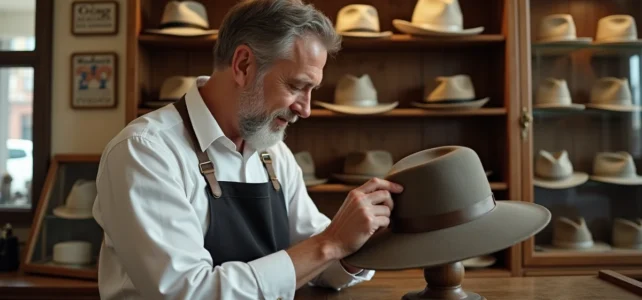
The professional who sells hats in a shop has a specific name, rooted in a French artisanal tradition that dates back several centuries. Two terms coexist depending on the type of activity performed: hat maker and milliner. The distinction between these two professions remains vague for most buyers, and the professional boundaries have blurred over time.
Hat maker and milliner: two distinct professions in hat making
The hat maker manufactures and sells hats, historically masculine, made from felt, straw, or other materials. His work involves shaping cones or bells on wooden forms, a technical skill that requires mastery of raw materials and blocking tools.
The milliner, on the other hand, designs and sells hats that are more feminine, often unique pieces or small series. Her approach is more about artistic creation: assembling fabrics, feathers, veils, flowers. Milliners frequently work on custom orders for events (weddings, horse races, ceremonies).
Knowing the name of the hat seller therefore implies knowing what type of headwear is concerned. A hat maker works with felt and straw, while a milliner sculpts custom creations. In practice, many professionals wear both hats, if one dares to say so.
- The hat maker masters the shaping, sanding, and dyeing of raw materials to produce structured hats (felt, panamas, top hats).
- The milliner assembles decorative elements on lightweight bases, with sewing and textile sculpting work akin to haute couture.
- The generic term “hat making” refers to both the retail business, the manufacturing workshop, and the professional sector as a whole.

Hat making in France: an art between workshop and shop
French hat making has long been concentrated in a few specialized cities. Historic houses still exist, particularly in Paris, where the tradition of custom hats has never completely disappeared despite the decline of headwear fashion in the mid-twentieth century.
What distinguishes an artisanal hat shop from a simple point of sale is the presence of a workshop. The hat maker who shapes his own pieces offers a fitting service tailored to the exact size of the customer. He adjusts the head circumference, modifies the curvature of the brim, adapts the height of the crown. This customization work is impossible in a large store or with a retailer of industrial caps.
The quality of a handmade hat is judged by the fineness of the felt and the uniformity of the shaping. A high-quality felt has a smooth, even surface, without texture irregularities. The most sought-after materials remain rabbit fur for common felts and beaver fur for high-end pieces, while toquilla straw (used for panama hats) comes exclusively from Ecuador.
The role of advice in the shop
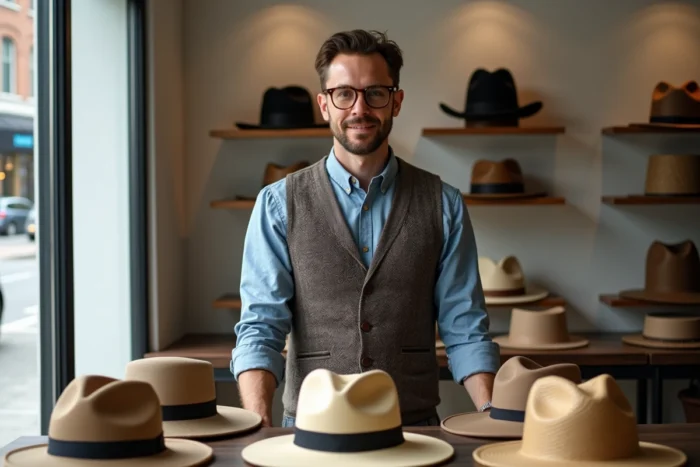
A hat maker in a shop does not just sell. He guides the customer towards the shape that suits their morphology: a round face does not wear the same style as an elongated face. This personalized advice constitutes the main added value compared to online shopping.
The hat shops that endure are those that have managed to combine in-store sales with a digital presence. The collection displayed in the shop serves as a showcase, while the website allows reaching a geographically distant clientele.
Cap, beret, bucket hat: all sold by the hat maker?
The question deserves to be asked, as the scope of the hat maker’s profession has expanded. Historically, the hat maker only sold hats in the strict sense: felts, top hats, bowlers, wide-brimmed hats. Caps fell under the domain of cap making, and berets under the domain of hosiery.
Today, most hat shops offer caps, berets, bucket hats, and beanies alongside traditional hats. This diversification responds to customer demand for a point of sale specialized in headwear in a broad sense, not just in classic hats.
However, an online cap seller or a large retailer cannot claim to be a hat maker. The title implies knowledge of materials, shapes, and manufacturing techniques that simple resale does not entail. Hat maker denotes a skill set, not just a sales act.
Milliner: a title protected by usage more than by law
No French regulation requires a specific diploma to open a hat shop or declare oneself a milliner. Available data does not confirm the existence of a legal framework protecting these titles. In practice, it is the recognition by peers and customers that establishes a professional’s reputation.
Training programs exist (CAP fashion and hat making, workshop training), but they do not condition the practice of the profession. An artisan can self-train and open their shop freely.
Sun protection and hats: a recent health role
An often-overlooked angle in the world of hat making concerns the integration of hats into occupational risk prevention policies. In recent years, recommendations regarding heat waves at work have emphasized the provision of sun protection equipment for employees exposed outdoors, explicitly including hats and lightweight clothing.
The employer must adapt equipment in case of orange or red heat wave alerts. This obligation gives the hat a function that goes beyond fashion: it becomes a piece of protective equipment. Hat shops that provide wide-brimmed headwear made from natural materials (straw, lightweight cotton) directly address this growing need.
This health positioning opens a market for hat makers who know how to combine effective sun protection with acceptable style in a professional environment.
The hat maker remains the reference professional for purchasing a hat in a shop, whether the piece is a classic felt, a straw panama, or a milliner’s creation. Behind this title lies a profession of advice, manufacturing, and adjustment that is not limited to placing an item on a counter.