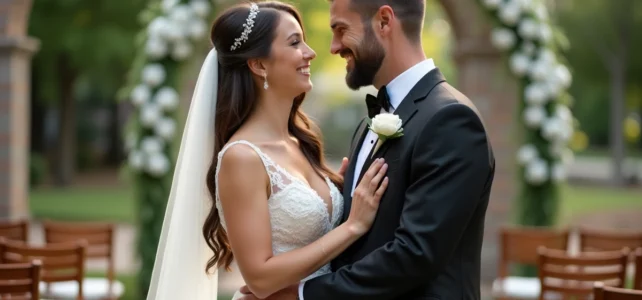
The wedding of Karima Brikh and Mathieu Bock-Côté generated a circulation of images on social media without any media producing a photo report framed by a clear editorial agreement. This ambiguity surrounding the published snapshots deserves attention even before commenting on the ceremony.
Circulation of wedding photos and the issue of image rights
Almost all visuals associated with the wedding of Karima Brikh and Mathieu Bock-Côté come from republishing on Instagram, Facebook, and a few entertainment sites. No official photographer has been credited in the publicly accessible results.
This lack of primary source poses a concrete problem. Republishing wedding photos without permission exposes one to legal action, whether in Quebec under the right to image or in France under Article 9 of the Civil Code. Content aggregators that disseminate these images do not mention either the photographer’s name or the licensing conditions.
For those who wish to view the wedding of Karima Brikh and Mathieu Bock-Côté in a respectful framework, the distinction between content shared voluntarily by the couple and a snapshot taken by a third party remains crucial.
We are increasingly observing this pattern with media personalities: photos circulate before any validation, and the visual narrative escapes the main interested parties.
Karima Brikh and Mathieu Bock-Côté: two distinct media paths
Karima Brikh is a journalist and presenter, graduated in journalism from UQAM. She has worked for TVA, LCN, and MATV, collaborated on several radio and television shows, and produced her first documentary for Radio-Canada in 2018, titled Amour Cougar: beyond the myth.
Mathieu Bock-Côté, born on August 20, 1980, in Lorraine in the Laurentians, is a sociologist, teacher, essayist, and columnist. Educated at the University of Montreal and the University of Quebec in Montreal, he focuses his work on the evolution of Quebec sovereignty, multiculturalism, and the role of national identity in political debates.
Favorable to Quebec’s independence, he advocates nationalist, liberal, and conservative positions. Le Figaro Magazine dedicated its cover to him in November 2023 on the occasion of the release of his book “Totalitarianism without the Gulag.”
The couple thus brings together two complementary media profiles: a field journalist and a public intellectual. This dual exposure partly explains the public’s curiosity about their private life.
Wedding photos of personalities: what the snapshots reveal about current trends
Beyond the couple themselves, images of this type of ceremony fuel the searches of future brides and grooms seeking inspiration. Several recurring visual elements stand out from recent media-covered weddings.
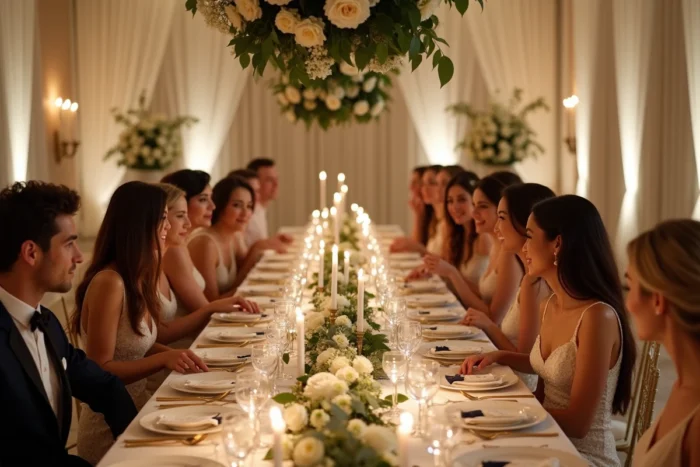
- The more experiential culinary staging, with presentations that favor sharing at the table rather than the classic buffet
- The attention to natural floral decorations, often asymmetrical, which replace the rigid compositions of a few years ago
- The choice of atypical venues (private estates, cultural spaces) rather than traditional reception halls
The wedding photos of personalities directly influence couples’ choices, even when these snapshots have not been disseminated in a professional context. The mere fact that an image circulates on social media is enough to create a trend.
Media-covered wedding: the line between legitimate curiosity and respect for privacy
The wedding of Karima Brikh and Mathieu Bock-Côté illustrates a tension that we systematically find with public figures. Fame does not eliminate the right to privacy, but it makes this right more difficult to exercise.
The content available online about this wedding mostly comes from aggregator-type pages or social media posts. No in-depth editorial treatment, with interviews and authorized photo reports, has been identified in the accessible sources.
This observation is not trivial. For a couple whose two members work in the media, controlling their own image is a professional as well as a personal issue. Karima Brikh, accustomed to producing audiovisual content, is well aware of the mechanics of image dissemination.
Mathieu Bock-Côté, regularly present in French and Quebec media, knows that every public appearance is subject to capture and redistribution. However, the wedding remains a private moment, and the distinction between public figure and private person fully applies in this context.
What wedding photos do not show
The circulating snapshots provide a fragmented view of the ceremony. Some elements remain systematically absent from the images shared without consent:
- The choice of the exact location, often protected by media couples to avoid intrusions
- The guests present, whose list falls strictly within the private sphere
- The logistical details (caterer, official photographer, organization) that are of interest to industry professionals
These gaps remind us that photos shared on social media do not constitute a report. They offer a glimpse, not a narrative. For future brides and grooms seeking inspiration from these images, caution is advised: what seems spontaneous has often been carefully framed, and what is missing sometimes says more than what is shown.
The wedding of Karima Brikh and Mathieu Bock-Côté will likely remain in this gray area where public interest coexists with the couple’s desire to preserve their intimacy. The available photos satisfy curiosity without fulfilling it, which may be exactly the sought-after balance.