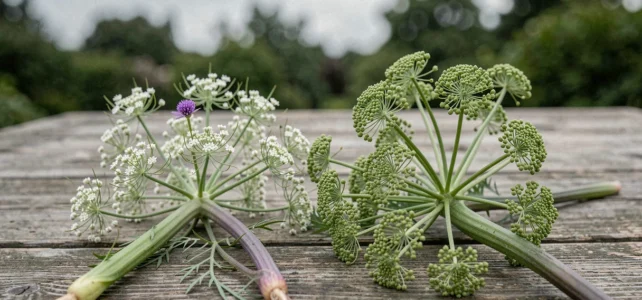
Wild carrot (Daucus carota) and poison hemlock (Conium maculatum) both belong to the Apiaceae family, formerly known as Umbelliferae. They share a similar growth habit, dissected leaves, and umbels of white flowers. This botanical relationship makes confusion possible, with a serious risk of poisoning since hemlock is among the most toxic plants in the European flora.
Overall approach before details: the plant’s silhouette
Most foraging guides focus on isolated criteria (stem color, leaf shape). In the field, this method quickly shows its limitations. A more reliable approach is to first observe the overall silhouette of the plant before moving on to morphological details.
Wild carrot rarely exceeds knee height in the vegetative stage and reaches about one meter during full bloom. Poison hemlock, on the other hand, can far exceed this size. The way the umbel stands out in the vegetation also differs: that of wild carrot often forms a slightly domed shape, while that of hemlock spreads out more, supported by a more branched architecture.
Learning to differentiate wild carrot and hemlock starts with this instinct for a global reading: height, growth habit, foliage density. If the silhouette does not match what you expect, there is no need to go further.

Stem and smell: the two most reliable criteria in the field
The stem, an immediate visual marker
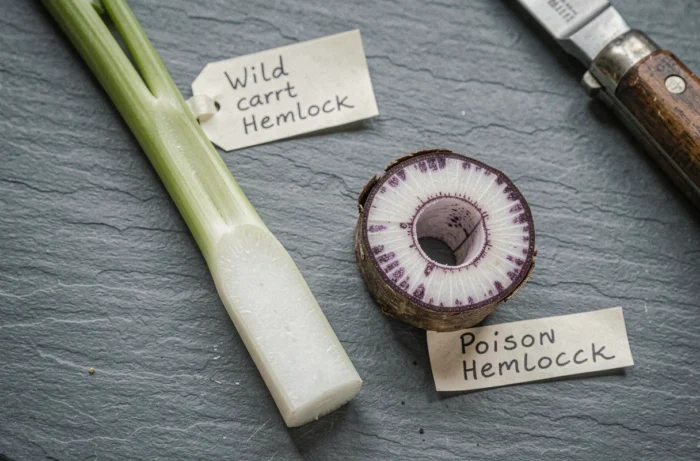
The stem of wild carrot is covered with stiff hairs, clearly visible to the touch and the naked eye. It is solid (not hollow) and of a uniform green color. The stem of poison hemlock has a radically different appearance: smooth, hollow, and especially dotted with irregular purple-red spots. These marks are the most frequently cited distinguishing feature, rightly so.
Be careful not to confuse these spots with simple dirt or age-related pigmentation. On hemlock, they appear from the early stages of growth and cover a good part of the stem.
Smell, a decisive complementary test
Crumpling a leaf between your fingers provides valuable information. Wild carrot emits a distinct carrot smell, unmistakable. Poison hemlock, on the other hand, releases a foul odor, often compared to mouse urine. This olfactory test works well on fresh leaves, less so on dried or damaged plants.
These two combined criteria (hairy and solid stem + carrot smell) are usually sufficient to confirm identification. But any doubt, even slight, should lead to abandoning the foraging.
Leaves and flowers of wild carrot: complementary botanical markers
The leaves of wild carrot are finely dissected, with narrow segments and a slightly hairy texture to the touch. Those of hemlock, although also dissected, are wider, more triangular in their cuts, and perfectly glabrous (smooth, without hairs).
Regarding the flowers, wild carrot has a remarkable feature: a small central purple flower in the middle of the white umbel. It is sometimes called “the carrot fly.” This visual marker is not systematic (it may be absent in some specimens), but when present, it confirms the identification.
Another useful clue: the bracts. Under the umbel of wild carrot, one observes bracts divided into fine segments, resembling small leaves. Hemlock lacks these or has only very discreet ones at the base of the secondary umbels.
- Hairy and finely dissected leaves: wild carrot. Glabrous and more broadly triangular leaves: hemlock.
- Central purple flower in the middle of the umbel: wild carrot (not always present, but never observed in hemlock).
- Well-visible divided bracts under the umbel: wild carrot. Absent or very reduced bracts: hemlock.
Foraging Apiaceae: why wild carrot remains an “advanced” plant
Despite these seemingly simple criteria, several foraging specialists recommend considering wild carrot as a plant reserved for experienced foragers. The reason lies in the number of toxic Apiaceae present in the French flora: besides poison hemlock, lesser hemlock (Aethusa cynapium), water hemlock, and fool’s water hemlock pose similar risks of confusion.
The most cautious field rule can be summarized as follows: never validate an identification based on a single criterion. The stem, smell, leaves, bracts, and central flower must all match. If the plant is too young, damaged by the weather, or partially wilted, some of these criteria become unreadable.
- Check the stem (hairs, color, any spots) and cut it to observe if it is solid or hollow.
- Crumple a leaf and smell: carrot smell or foul odor.
- Look for the central purple flower and the bracts under the umbel.
- If in doubt about any one of these points, abandon the harvest.
For beginners, the safest recommendation remains to not harvest any white umbel without the accompaniment of a trained person. Participating in a guided botanical outing allows for handling both plants side by side, which anchors the differences much better than a written description.
The root of wild carrot, whitish and fibrous, also emits a characteristic carrot smell when cut. The root of hemlock does not have this smell. But pulling a root for identification remains a last resort, reserved for situations where doubt persists after a thorough examination of the aerial part.
The line between edible and deadly plants among the Apiaceae sometimes hinges on details that only repeated practice can anchor. No photo can replace direct observation in the field.