
A knocking sound from the exhaust pipe indicates a repeated mechanical impact between two metal surfaces. This noise is distinct from a dull rumble or a whistle due to its dry and intermittent nature, often synchronized with the engine speed or the irregularities of the road. Identifying the faulty part requires understanding how each component of the exhaust system can generate this type of sound.
Thermal expansion after engine shutdown: the false knock not to be confused
Before looking for a malfunction, it is essential to rule out a common physical phenomenon. A few minutes after turning off the engine, the exhaust system often emits a regular metallic click-click that gradually fades away. This noise comes from the contraction of the metal cooling after having been subjected to several hundred degrees during operation.
This thermal expansion crackling does not indicate any failure. It occurs on all vehicles, with the engine off and the vehicle stationary. The difference from a true pathological knock lies in two criteria: the expansion noise occurs only after shutdown, and it disappears within a few minutes. A knock related to a defective part, on the other hand, manifests while the engine is running, often during acceleration or on a degraded road.
A detailed article outlining the causes of exhaust knocking noise helps distinguish these situations and avoid an unnecessary trip to the mechanic for a perfectly normal phenomenon.
Heat shield and protective plates: the most underestimated cause
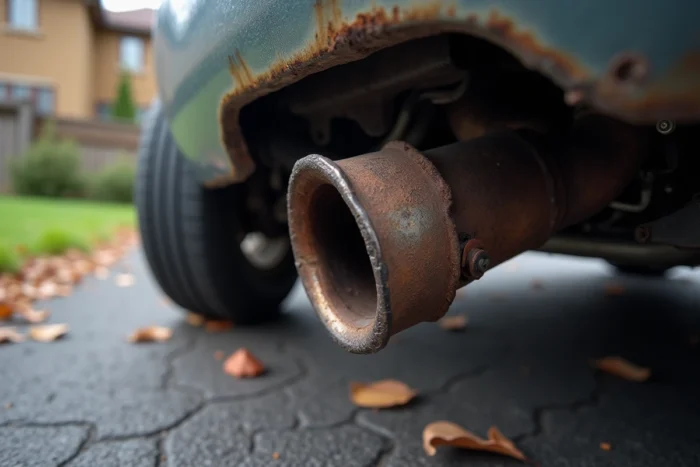
The heat shield is a thin plate fixed around the catalytic converter or muffler to protect the floor and nearby components from heat. Over time, the fastening points (screws, clamps, rivets) corrode or loosen. The plate then vibrates freely and produces a characteristic metallic knock.
This noise has a recognizable signature: it appears mainly at certain engine speeds or on deformed road surfaces when the vibrations transmitted by the chassis resonate the plate. It may temporarily disappear if the vibration frequency changes, complicating the diagnosis in the workshop when the vehicle is idling on a lift.
The most reliable diagnosis involves placing the vehicle on jack stands and manually shaking each protective plate and shield along the exhaust system. A poorly secured element can be immediately identified by touch and sound. The repair remains simple in most cases:
- Tighten or replace corroded fastening clamps with new stainless steel clamps
- Install a large tightening clamp (reinforced type) to temporarily hold a shield in place until it can be replaced
- Replace the entire shield if the plate itself is cracked or corroded through
The cost of this intervention remains modest compared to replacing a muffler or catalytic converter. Ignoring the problem does not pose an immediate mechanical risk, but a missing heat shield exposes the floor to excessive heat, which can damage insulation or nearby cables.
Rubber mounts and muffler mounting rings: dynamic knocks
The exhaust system is suspended under the vehicle by rubber supports called rubber mounts (or mounting rings). These parts absorb movements and vibrations to prevent the exhaust pipe from hitting the chassis or floor.
When a rubber mount cracks, hardens, or breaks, the muffler loses its suspension. It then begins to oscillate freely and strikes surrounding elements. The knocking occurs in specific situations:
- During strong acceleration, when the engine torque slightly pivots the engine block and pulls on the exhaust system
- During hard braking, when inertia pushes the exhaust pipe towards the front of the vehicle
- On a rough road, when suspension movements amplify the muffler’s travel
This type of knock is distinguished from a shield noise by its direct correlation with dynamic driving phases. At idle, with the engine running and the vehicle stationary, the noise is often absent.

The visual inspection of the rubber mounts is done from underneath the vehicle. A cracked, deformed, or missing rubber can be easily spotted. Replacing a muffler rubber mount typically takes less than an hour and the part is inexpensive. However, neglecting the problem risks damaging the muffler itself or the piping due to repeated impacts.
Catalytic converter and perforated muffler: when the knock hides a deeper problem
A catalytic converter with a fragmented ceramic substrate produces a rattling or internal knocking noise, like pieces of ceramic colliding inside the casing. This noise is characterized by the fact that it comes from inside the muffler itself, without contact with an external element.
The fragmentation of the substrate reduces pollution control efficiency and can cause partial clogging, leading to a loss of power and increased fuel consumption. A catalytic converter in this condition requires replacement, as no repair is possible on the internal structure.
A muffler perforated by corrosion produces a dull and continuous noise rather than a dry knock. The nuance is important for guiding the diagnosis. A localized perforation can be temporarily sealed with high-temperature exhaust putty, but a heavily corroded muffler must be replaced to pass the technical inspection without a follow-up visit.
The knocking from the exhaust pipe often leads to a part costing a few euros (clamp, rubber mount) rather than a heavy repair. The most cost-effective reflex remains to visually and manually inspect the entire system, from the collector to the rear exit, before ordering anything.