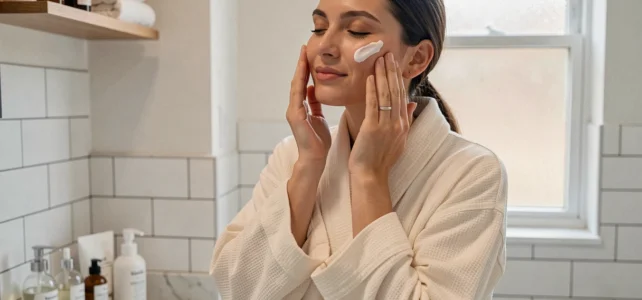
The European regulation on cosmetic ingredients is evolving faster than most beauty routines. Adapting your facial and body care to these concrete changes, while optimizing the effectiveness of each action, requires understanding what is actually happening on the skin rather than following generic advice lists.
Retinol and facial care: what Regulation (EU) 2024/996 changes in your routine
Serums and night creams formulated with retinol have been the cornerstone of anti-aging routines for years. The European Commission has adopted Regulation (EU) 2024/996, which caps leave-on facial products at 0.3% retinol equivalents and body lotions at 0.05%.
Non-compliant products will no longer be allowed on the market starting November 1, 2025. All those exceeding these limits must be removed from shelves by May 1, 2027, at the latest.
We recommend checking the INCI list of your products containing retinol, retinyl acetate, or retinyl palmitate now. A serum labeled as 1% pure retinol, common in today’s market, will simply no longer be marketable in its current form in the European Union. Children under three years old and sunscreens are subject to a total ban on these vitamin A derivatives, regardless of concentration.
In practice, brands are reformulating. Alternatives like bakuchiol or compliant doses of retinaldehyde are gaining ground in anti-aging lines. Rather than accumulating retinol serums before their withdrawal, it’s better to test these substitutes now to assess skin tolerance over several weeks. The resources available on lebreakbeaute.fr allow you to track these reformulations and identify products already compliant with the new caps.
Fragrance allergens: read the label of your cosmetics daily
Another regulatory aspect is flying under the radar of classic beauty articles. The labeling of fragrance allergens in cosmetics has been strengthened in the EU, with new substances that must be declared on the packaging.
This is not just a matter of industrial compliance. For anyone prone to redness, itching, or reactions after applying a scented facial cream or body care, reading the INCI list becomes a non-negotiable reflex.
Substances to watch for in your products
- Linalool and limonene remain the most common allergens in scented products, including those labeled “natural” or “organic.”
- New allergens identified by the European Scientific Committee must now appear on packaging, which lengthens the INCI list of many products.
- Formulations labeled “fragrance-free” do not guarantee the absence of these molecules when they come from significant oils included for other properties.
We observe that many consumers confuse “synthetic fragrance” with “allergen.” A significant lavender oil naturally contains linalool. The relevant criterion is not whether it is of natural or synthetic origin, but the actual presence of the allergenic molecule on the INCI list.
Skin microbiome and choice of cleansing products
Overly aggressive cleansing degrades the skin microbiome long before visible dryness occurs. The surface bacterial flora acts as a barrier against pathogens and helps regulate sebum. High pH cleansers, concentrated sulfates, and daily mechanical scrubs disrupt this balance.

In the morning, a rinse with lukewarm water is sufficient for most skin types. In the evening, double cleansing (oil or balm followed by a gentle cleanser with physiological pH) remains the most respectful protocol for the skin barrier, provided you do not scrub.
Criteria for selecting a gentle facial cleanser
- pH between 4.5 and 5.5, which corresponds to the natural pH of the skin surface.
- Gentle surfactants (coco-glucoside, decyl glucoside) rather than sodium lauryl sulfate.
- Absence of added fragrance if the skin shows reactivity or chronic redness.
- Rinsed formula rather than wipes, to limit repeated mechanical friction.
Switching cleansers requires an adjustment period of two to three weeks. Judging a cleansing product in less than ten days does not reflect its actual effect on the microbiome.
Moisturization and facial cream: the question of application order
The order of application of products is not a marketing convention. It is based on a simple physicochemical principle: lighter, more aqueous textures penetrate first, while more occlusive ones seal in moisture last.
Applying a rich cream before a watery serum prevents water-soluble actives from reaching the epidermis. Watery serum, then cream, then oil or balm if necessary: this order increases the bioavailability of actives at each step.
The day cream with SPF is positioned as the last step in the routine, before makeup. Sunscreen filters must form a continuous film on the surface to be effective, which excludes mixing them with a serum or applying them under an occlusive cream.

For hair, the same principle applies: lightweight leave-in treatments (mists, hair serums) should be used before styling oils or balms. Layering products out of order weighs down the hair without providing additional benefits.
The most effective beauty routines are not those that include the most products. An appropriate cleanser, a targeted serum based on the primary need (hydration, radiance, firmness), a protective cream, and an SPF cover the daily needs of the vast majority of skin types. Adding an extra treatment is only justified if a dermatological diagnosis or a specific seasonal need requires it.