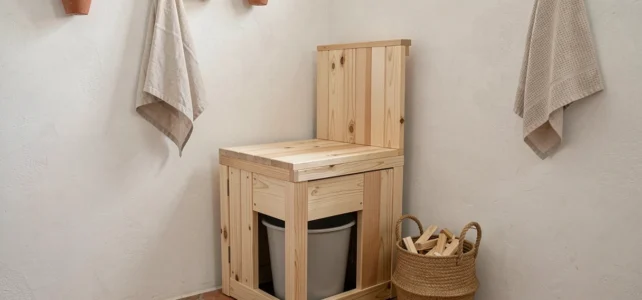
When living in an old house without a sewage system or when setting up an outbuilding at the back of the garden, the question of sanitation without connection quickly arises. Ikea does not sell dry toilets as such: the brand offers modular furniture that some people repurpose, but the result remains a makeshift solution without health guarantees or lasting comfort.
Exploring ecological alternatives to dry toilets designed from the outset changes the game, both in terms of odor management and system durability.
Urine-solid separation: the technical criterion that changes everything
Most setups based on Ikea furniture rely on a single bucket where urine and solid waste mix. This mixture accelerates anaerobic fermentation, generates ammonia, and complicates composting.
Models designed by specialized manufacturers incorporate a urine separator right from the bowl. The urine is diverted to a sealed tank or a drainage pipe, while the solid waste falls into a wood chip bin. The result: odors drop significantly, and the contents of the bin dry faster.
Today, several European brands offer bowls with integrated separation, suitable for daily use in homes. The seating comfort is similar to a conventional toilet, making it easier for all household members to adopt. When looking for ecological alternatives to Ikea dry toilets, this design point makes the difference between a system used for six months and one that lasts for years.
Composting or incinerating dry toilets: two systems, two constraints
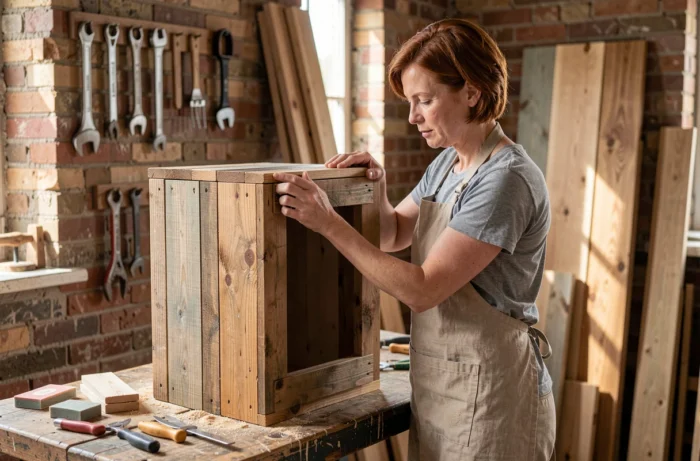
Talking about dry toilets as a single block is misleading. Two main families coexist, and the choice depends on the available space and the management of waste one is willing to take on.
Composting toilets
The principle is simple: a carbon material (wood chips, sawdust, hemp straw) covers each deposit. The full bin goes to an outdoor composter where the material decomposes over several months. Composting requires a dedicated outdoor space and regular monitoring of moisture levels.
- Moderate purchase cost, inexpensive consumables (sawdust recoverable from a local sawmill).
- Emptying the bin every three to seven days depending on the number of users.
- The compost obtained after maturation can be used at the base of fruit trees or hedges, but never on vegetable crops that are consumed raw.
Incinerating toilets
Here, each use is followed by a combustion cycle that reduces waste to sterile ashes. No composter is needed, and there is no contact with the material. However, the electrical consumption per cycle is high, and the device requires a smoke evacuation duct comparable to that of a stove.
For a primary residence occupied by four people, feedback varies on this point: some users report a notable energy cost, while others find it acceptable compared to the eliminated water bill.
French regulations on non-potable water and dry toilets in 2024
Decree No. 2023-835 of August 29, 2023, supplemented by the order of July 12, 2024 (effective September 1, 2024), strictly regulates the use of non-potable water inside homes. Rainwater, for example, is only allowed for flushing toilets, washing floors, and laundry, provided there is a total separation of networks, clear “non-potable water” signage, and maintenance of a health record.
This regulatory framework repositions dry toilets as an option that avoids all this complexity. No non-potable water network to install, no double piping, no health record. For a homeowner renovating a rural house, removing the flush simplifies compliance rather than complicating it.
Concrete criteria for choosing a suitable dry toilet for the home
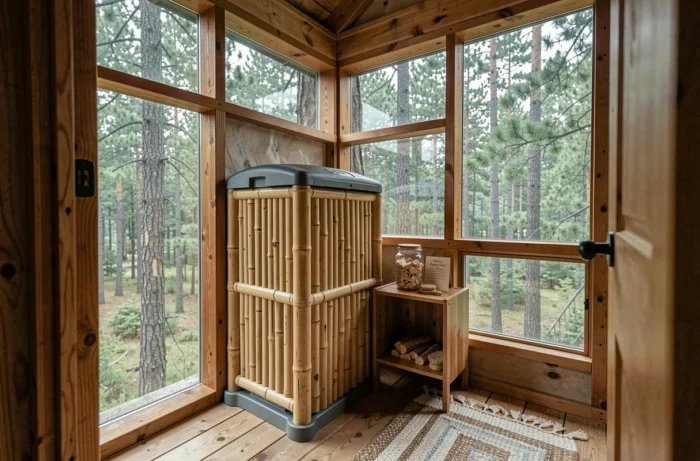
Before ordering, it saves time to check a few points often overlooked during purchase.
- Seat height: a model that is too low strains the knees. Aim for the same height as a standard toilet, around 40 cm.
- Bin capacity: a small volume tank requires frequent emptying. For a household of two to three people, plan for a bin that lasts at least four days.
- Integrated ventilation: a small 12 V fan connected to an extraction pipe leading outside eliminates almost all residual odors. Without this device, even a good separator allows odors to escape in summer.
- Materials of the bowl: ABS plastic holds up well, but stainless steel or ceramic models offer superior durability and are easier to clean.
The price of a fully separating dry toilet exceeds that of a DIY setup, but the long-term reliability and absence of leaks justify the investment for daily use in a primary residence.
Indoor odor management: ventilation and carbon material
This is the first psychological barrier. Dry toilets are often associated with odors, usually due to poorly ventilated installations or buckets without separation.
A well-designed system combines three elements: the urine-solid separator, an appropriate supply of carbon material (softwood chips work better than hardwood sawdust due to their absorbent power), and low-consumption continuous mechanical ventilation. The airflow passes through the bin and exits through a wall duct or a 75 mm PVC pipe running through the roof.
With this triple barrier, feedback from users in homes confirms the absence of noticeable odor in the room, even during summer. The point to monitor remains the sealing of the urine collection bin: a poorly tightened seal is enough to create a nuisance.
Adopting dry toilets in a primary residence is as much a technical choice as an ecological one. The key lies less in the brand of the furniture than in the quality of the separation, ventilation, and composting monitoring. A system designed for this use from the outset makes daily life simple, whereas repurposing furniture often leads to sealing or comfort issues after a few months.