
A pole pruner is not chosen like a chainsaw. The weight-to-power ratio, the length of the guide bar, and the type of motorization directly affect the quality of the cut, muscle fatigue, and the risk of accidents. Here we discuss the technical criteria that consumer guides often overlook.
Ergonomics and muscle fatigue: the underestimated criterion for a pole pruner
Power and guide length dominate comparisons. The parameter that truly determines the duration of work without the risk of injury is the management of postural fatigue.
On a pole pruner, the weight is transferred to the shoulders, trapezius, and lower back. Beyond thirty minutes of continuous work with arms raised, cutting precision drops and the risk of dropping the tool increases. A double harness (type of distributing harness) radically changes the game compared to a simple shoulder strap.
The cutting angle matters as much as the working time. Approaching a branch at 90° puts much more strain on the back than a cutting angle between 30 and 45 degrees. This inclination protects the lower back and promotes a clean cut without tearing the bark. We recommend systematically testing the grip and balance of the pole before purchase, especially on telescopic models where the center of gravity shifts back when extending the pole.
The catalogs available on elagueuse-warrior.com allow for comparing weight and length specifications across various ranges of pole pruners, both gas-powered and battery-operated.

Lithium battery or gas engine: decide based on the actual cutting diameter
The debate between gas and battery is often reduced to “power versus silence.” The real question concerns the diameter of wood you actually cut on a daily basis.
Next-generation battery pruners, powered by high-capacity lithium-ion packs, deliver performance considered close to gas-powered models on branches up to an average diameter. Their torque is sufficient for most routine maintenance tasks on fruit trees, tall hedges, and softwood. The advantage goes beyond sound comfort: a quieter tool without thermal vibration makes prolonged use of PPE easier (helmet with visor, hearing protection, cut-resistant gloves).
The gas engine maintains a clear advantage in two specific areas:
- Long interventions on hardwood (oak, beech, ash) where the autonomy of a standard battery does not cover the entire session.
- Jobs far from any power source, where carrying multiple batteries adds weight to the kit and increases equipment costs.
- Larger cutting diameters requiring a long guide bar and sustained engine speed for several consecutive minutes.
One often overlooked point: a single battery can power an entire range of tools (hedge trimmer, blower, chainsaw). If you already own a battery ecosystem from a given manufacturer, the marginal cost of the pruner drops significantly since you only purchase the tool body.
Guide bar and chain pitch: technical specifications to check before purchase
The length of the guide bar determines the maximum cutting diameter in a single pass. On a compact pruner (top handle), common guide lengths are around 25 cm. This size is suitable for small to medium diameter branches, typical of maintenance pruning.
The chain pitch influences cutting speed and vibrations. A reduced chain pitch (type 1/4 inch) generates less vibration and offers a finer cut, suitable for precision cuts on fruit or ornamental trees. A low-profile 3/8 inch pitch remains the versatile standard for consumer and semi-professional pruners.
Chain tension and operational safety
A poorly tensioned chain can derail. A tool-less tensioning system (side knob) allows for quick adjustments in the field in seconds, without having to set the machine down and search for a screwdriver in the bag. This technical detail separates models designed for work at height from those simply derived from miniaturized chainsaws.
The chain brake must activate by inertia in case of kickback, not just by manual action on the lever. Check this point on the technical sheet: an inertia chain brake is non-negotiable on any model used at height.
PPE and pruning: why the choice of tool influences the use of protective gear
Recent field data shows that the systematic use of personal protective equipment reduces the risk of severe injuries in pruning by about 70%. The link with the choice of tool is direct.
A heavy, noisy, and highly vibrating pruner encourages the user to remove their gloves (loss of grip), lift their visor (fogging, heat), or shorten the use of hearing protection. In contrast, a lightweight battery model with moderate noise levels makes it feasible to wear full PPE throughout the duration of the job.
The minimum list of equipment for any pruning work, regardless of the type of pruner:
- Forestry helmet with mesh visor and integrated ear protection.
- Cut-resistant pants (protection class suitable for the chain speed of your model).
- Cut-resistant gloves with enhanced grip to maintain hold on the pole.
- High-top safety shoes with slip-resistant soles.
We observe that users equipped with battery pruners wear their PPE longer and more consistently than those using gas models, precisely because the overall comfort of use is superior.
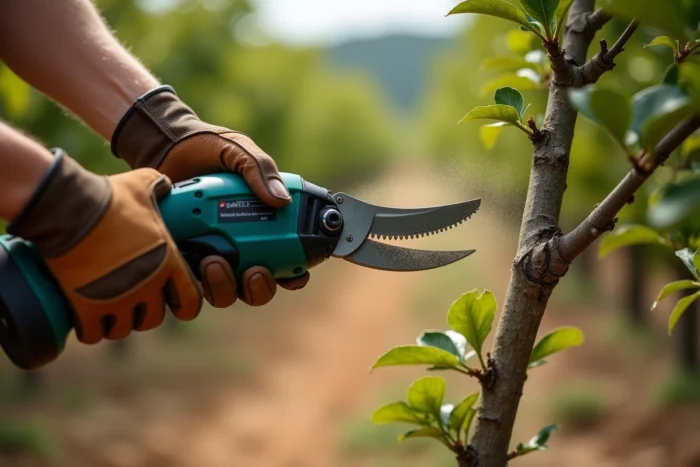
The best investment in pruning is not the most powerful machine, but one whose weight, balance, and noise level allow you to work with all your protective gear for the entire duration of the intervention. An inertia chain brake, a distributing harness, and a battery compatible with your other tools weigh more in the balance than a handful of additional cubic centimeters.