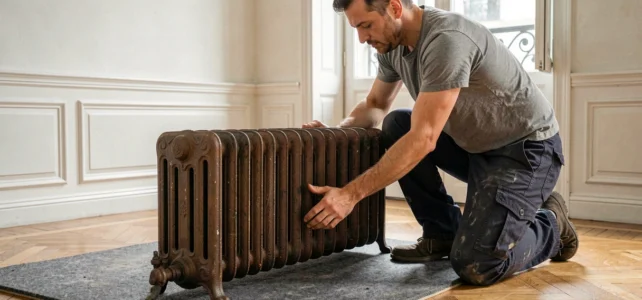
A classic cast iron radiator weighs several dozen kilograms, sometimes much more depending on the number of elements. Placing this type of load on an old floor or a floating floor without precautions leads to concentrating considerable pressure on just a few square centimeters. The wood gets marked, the boards bend, and the damage becomes irreversible once the radiator is filled with water.
Point load on flooring: the real problem to solve
The difficulty does not come from the total weight of the radiator, but from how this weight is distributed on the ground. A cast iron radiator rests on two or four feet, whose support surface is very small. This concentration of point load far exceeds what a floating floor or an old solid floor can withstand without deformation.
On a floating floor, the resilient underlay amplifies the phenomenon: it compresses under the feet, creating a localized indentation and potentially causing the boards to separate from each other. On a nailed solid floor, the risk is more about crushing the wood fibers and the appearance of permanent marks.
The basic principle is therefore to distribute the load over the largest possible surface to bring the pressure per square centimeter to a level that the flooring can tolerate. Any technical solution that does not address this distribution point is doomed to fail, regardless of the type of flooring. To clarify the precautions related to radiator feet, you can learn more on the idhabitat.fr website before choosing your method.
Distribution plate for cast iron radiator: materials and sizing
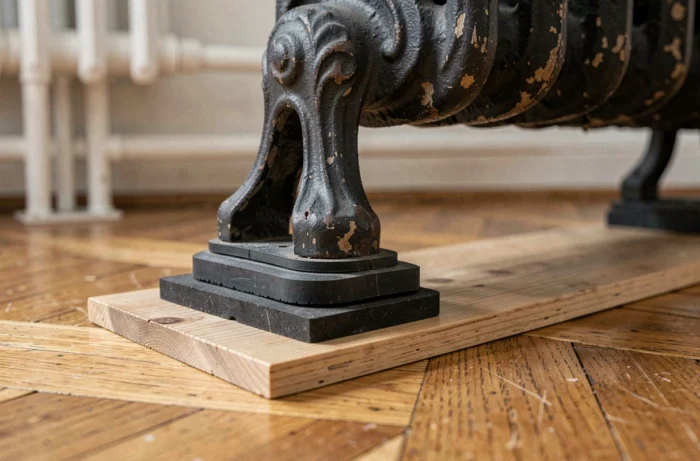
The most recommended solution by recent technical guides is to place a rigid distribution plate between the feet of the radiator and the flooring. This plate absorbs the point pressure and redistributes it over a larger surface.
Material selection
Several materials are suitable, provided they combine rigidity and moisture resistance:
- Marine plywood (15 to 20 mm thick) offers a good compromise between rigidity and lightness, while resisting potential micro-leaks at the joints.
- A metal plate (steel or aluminum) a few millimeters thick works perfectly for the heaviest loads, but can mark the flooring if its underside is not protected by felt or rubber.
- Hardwood (oak, beech) can serve as a plate, provided it is treated against moisture and has sufficient thickness to avoid bending.
Plate sizing
The plate must significantly exceed the footprint of the radiator feet. A plate that only covers the exact surface of the feet does not solve anything. The plate should extend at least ten centimeters on each side so that the load is distributed over several boards of the flooring simultaneously.
On a floating floor, the plate must rest flat on the covering without being fixed (neither screwed nor glued). The floating floor needs to maintain its freedom of movement. Fixing the plate to the ground would block the expansion of the flooring and cause buckling in the medium term.
Wall mounting of the cast iron radiator on fragile flooring
Distributing the load on the ground is not always enough. On a very old or particularly thin floor, the best approach is to transfer part of the weight to the wall using wall mounting brackets.
Wall brackets suitable for the weight of the radiator are fixed into the load-bearing wall (masonry, brick, concrete) with anchors sized for the load. The radiator then rests partially on the wall and partially on its feet, significantly reducing the pressure on the ground.
This method has a second advantage: it secures the radiator against tipping. A cast iron radiator resting solely on its feet, without wall mounting, can tip over in the event of a shock or handling. The combination of feet on a distribution plate and wall brackets constitutes the safest configuration for fragile flooring.
Case of floating flooring and underfloor heating: additional constraints
Placing a cast iron radiator on a floating floor installed over hot water underfloor heating adds a non-negotiable constraint. Technical guides related to NF DTU 65.14 advise against any through-fixing in the screed of an underfloor heating system to stabilize a radiator by its feet. The risk of puncturing a tube in the underfloor heating circuit is too high.
In this configuration, two solutions are recommended:
- Distribution plates placed freely on the covering, without any drilling, to support the radiator.
- Anti-tipping brackets fixed exclusively to the wall, so as not to stress the screed with any anchors at the floor level.
The floating floor over underfloor heating is often thinner and more sensitive to thermal variations. The distribution plate also plays a role in mechanical insulation between the metal foot (which transmits heat from the radiator) and the covering.
Surface protection under the plate
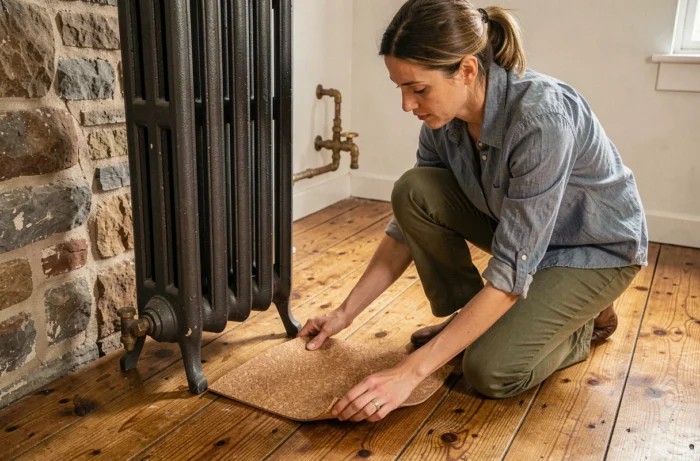
Inserting a thick felt or rubber sheet between the underside of the plate and the flooring protects against micro-scratches. The standard felt sold for furniture feet is not suitable: it compresses too quickly under a heavy load and loses its protective effect within a few months. A high-density felt or cellular rubber retains its mechanical properties much longer under permanent load.
The plate itself should have no roughness on the underside. Poorly sanded plywood or a metal plate with cutting burrs will scratch the flooring as soon as the radiator is installed.
Checking the condition of the protection every year during the radiator purge remains the simplest and most often overlooked precaution. A compressed or misaligned felt can be replaced in a few minutes, while the marks it should have prevented are permanent.