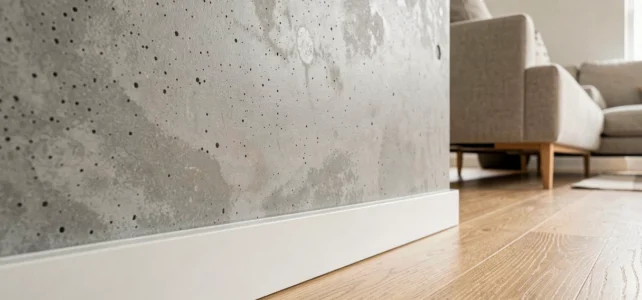
A polished concrete wall imposes a strong aesthetic choice: smooth surface, mineral tones, controlled raw appearance. The baseboard that accompanies it can enhance this finish or contradict it. The choice of material, profile, and installation depends as much on the room in question as on the very nature of polished concrete, a coating that is more demanding than it seems in terms of moisture and compatibility.
Polished concrete and moisture at the base of the wall: the trap that the baseboard can hide
Have you ever noticed a dark halo at the bottom of a polished concrete wall, just behind a baseboard? This phenomenon has a simple explanation. Polished concrete is naturally porous before the application of a protective varnish. Even once protected by a primer system, varnish, and wax, its weak point remains stagnant water at the base of the wall.
In a bathroom or kitchen, water that accumulates on the floor rises by capillarity behind the baseboard. If it is made of raw MDF or untreated wood, it absorbs this moisture and transmits it to the coating. The result: stains, powdering, or even blisters on the polished concrete.
Before choosing a baseboard model, it is therefore essential to check that the wall incorporates a complete waterproofing system (liquid membrane and suitable varnish) in humid areas. Without this precaution, even the most beautiful baseboard will eventually reveal a hidden flaw. The flexible joint between the baseboard and the floor deserves as much attention as the choice of material: it is what prevents water from migrating.
Choosing a polished concrete baseboard for treated walls requires understanding this technical constraint before thinking about style.
Baseboard materials compatible with a polished concrete floor and wall
Not all baseboard materials are equal when it comes to polished concrete. The choice depends on the room, the type of flooring, and the desired finish.
PVC and laminate: allies for humid rooms
In a bathroom or kitchen, professionals now favor PVC or laminated baseboards. These materials do not absorb moisture and are easy to clean. Their smooth surface matches the mineral appearance of polished concrete without creating too strong a contrast.
PVC comes in finishes that mimic concrete, stone, or brushed metal. It is glued directly, which avoids drilling into the wall and weakening the coating.
Aluminum: radical discretion
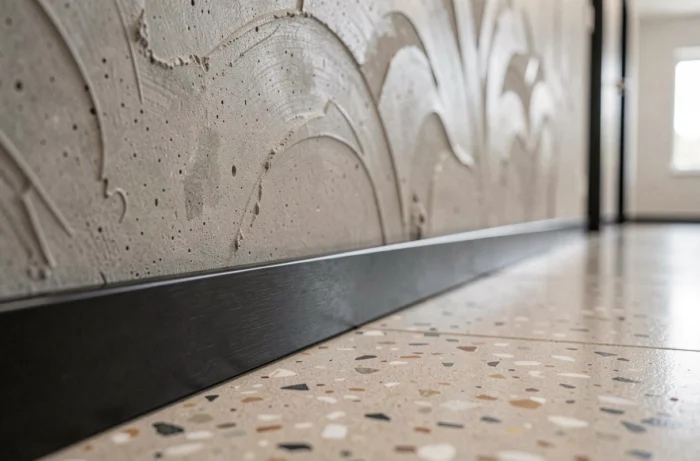
The brushed or anodized aluminum baseboard creates a fine, almost invisible line at the base of the wall. This material is resistant to water, impacts, and does not yellow. It is suitable for both dry and humid rooms. Its thin profile (often less than one centimeter thick) respects the flatness of the polished concrete without adding relief.
Solid wood or MDF: reserved for dry rooms
A wooden floor in the living room with a polished concrete wall? A solid wood baseboard can ensure the transition between the warmth of the floor and the mineral quality of the wall. Painted MDF also works, provided it remains in rooms without exposure to water. In an entryway or hallway, waterproof MDF offers an acceptable compromise.
- Humid rooms (bathroom, kitchen): PVC, laminate, or aluminum, with a flexible joint at the floor
- Dry rooms (living room, bedroom, hallway): solid wood, painted MDF, or aluminum depending on the style
- High-traffic areas (entryway, hallway): aluminum or PVC for their impact resistance
Height and profile of the baseboard: adapting the proportion to the polished concrete wall
The height of the baseboard alters the perception of the wall. A polished concrete applied to a large wall surface gains presence with a low and discreet baseboard. Conversely, a narrow wall or low ceiling struggles with a high baseboard that visually cuts the space.
A low baseboard visually extends the polished concrete wall down to the floor. This choice works particularly well with a flat profile, without molding, that does not break the smooth surface of the coating.
Rounded or molded profiles, common with painted or wallpapered walls, create a stylistic mismatch with polished concrete. The straight line and flat profile remain the most coherent options. A fine beveled profile can also work if the finish is matte.
Glued or clipped installation: what impact on polished concrete
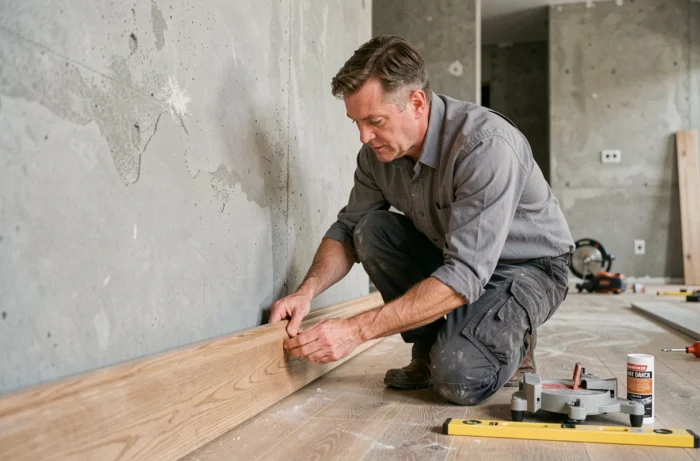
Drilling a polished concrete wall to fix a baseboard damages the coating. Screw or plug holes crack the protective layer and open entry points for moisture. The glued installation is the recommended method on a polished concrete wall.
Polymer adhesives (such as MS polymer) adhere to both polished concrete and the baseboard material without requiring drilling. They also allow for correcting slight flatness defects in the wall.
The clipped installation, used with certain PVC or laminated baseboards, works if the clips attach to the floor and not the wall. This detail matters: wall clips imply a screw in the polished concrete, which negates the benefit of the solution.
- MS polymer adhesive: compatible with polished concrete, no drilling, good durability
- Floor clips: possible with clip-on PVC baseboards, preserves the integrity of the wall
- Screws and plugs: to be avoided on a polished concrete wall, risk of cracking and infiltration
The choice between matte and satin finish for the baseboard also deserves consideration. A matte polished concrete paired with a shiny baseboard creates an unintended contrast. Matching the finish of the baseboard to that of the wall produces a more homogeneous result, especially in small rooms where every detail is noticeable.
The baseboard remains a finishing element, not a standalone decorative element. On a polished concrete wall, it should visually disappear or extend the material. Models tinted in the mass, in a tone close to the wall coating, fulfill this role better than a color contrast that draws the eye down the wall.