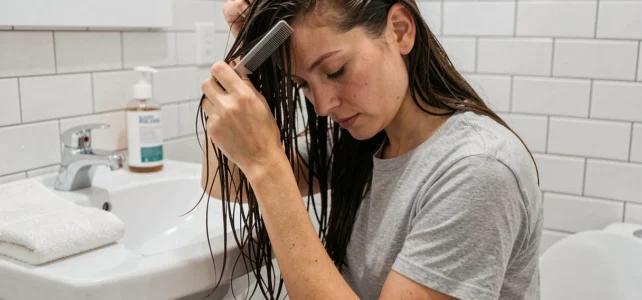
Fleas that end up in human hair often cause immediate confusion with lice. However, the distinction is crucial for choosing the right treatment. Cat or dog fleas can bite the scalp, but humans are not their primary host: they do not settle there permanently. Understanding this mechanism changes the entire approach, from diagnosis to treatment of the environment.
Fleas or lice in hair: why diagnosis determines everything
Before applying any product to the scalp, it is essential to identify the parasite. Head lice live exclusively in human hair, reproduce there, and lay eggs glued to the roots. Fleas, on the other hand, come from the environment or a pet and only pass over the scalp to feed.
Morphology helps to decide. Lice are flattened, grayish, and move slowly along the strands. Fleas are brown, rounder, and jump. If you observe insects jumping out of the hair while combing, you are dealing with fleas, not lice.
This distinction guides the treatment. Pharmacy-approved anti-lice lotions target lice and nits through a coating or dehydration mechanism. They are not designed to eliminate fleas, which have a radically different life cycle. Applying an anti-lice treatment to a flea infestation is like treating a symptom without addressing the cause.
To kill fleas in hair, the logic is reversed: the scalp is just a transit point, and it is the source (animal, habitat) that must be neutralized as a priority.
Scalp treatment against fleas: what works and what is a myth
So-called suffocating remedies (coconut oil, mayonnaise, white vinegar applied as a mask) circulate abundantly online. These methods are described in popular literature for lice, not for fleas. No consultable medical source validates their specific effectiveness against fleas present in hair.
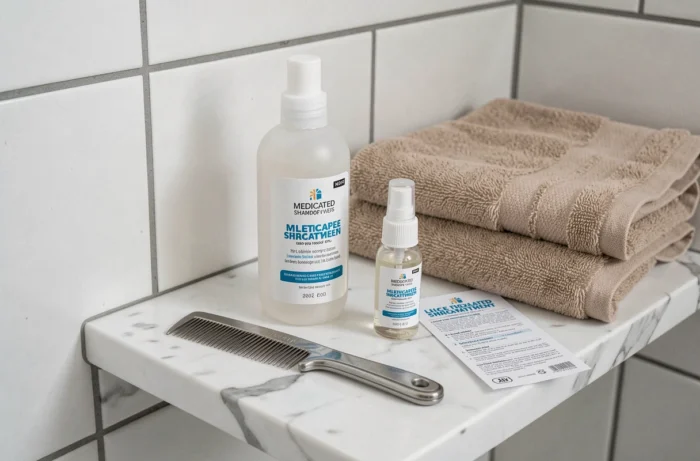
Fine combing remains the most reliable mechanical method to physically remove fleas from the scalp. Use a metal lice comb with very tight teeth on wet, detangled hair. Soapy water facilitates sliding and prevents fleas from jumping during the operation.
Shampoo alone is not enough
A regular shampoo, even vigorous, does not kill fleas. It may dislodge a few mechanically, but those that remain in the environment will recolonize the scalp within hours. Treating the hair without treating the habitat is like emptying a leaking bathtub without fixing the faucet.
Shampoos containing permethrin or pyrethrins, available at pharmacies, are sometimes mentioned. They act on lice and may have an effect on adult fleas upon contact, but their action remains limited if the source of infestation persists.
Fleas in the habitat: the real lever to protect hair
Fleas spend most of their life cycle away from their host. Eggs fall from the animal, hatch in textile fibers (carpets, rugs, cushions, bedding), and larvae develop in hiding before becoming adults. Pupae can survive for several weeks in a protective cocoon, even in the absence of an animal.
This is why treating the environment is the cornerstone of any anti-flea strategy, even when the bites concern the human scalp.
- Vacuum daily on floors, baseboards, corners of sofas, and under furniture. The vibrations from the vacuum stimulate the hatching of pupae, which accelerates the elimination of the cocoon stock.
- Wash all bedding, cushion covers, throws, and textiles in contact with animals at high temperatures (at least 60 °C).
- Use an insecticide suitable for domestic fleas (spray or fogger) containing an insect growth regulator, which prevents larvae from becoming adults. Apply in all rooms frequented by the animal.
- Simultaneously treat all household animals with a veterinary antiparasitic. Treating only one animal out of two leaves the reinfestation cycle intact.
Diatomaceous earth and natural repellents: real effectiveness against fleas
Food-grade diatomaceous earth often appears in natural recommendations. Its mode of action is mechanical: the microparticles of silica abrade the waxy cuticle of adult fleas, causing their dehydration. Sprinkled on the animal’s transit areas (baskets, door thresholds, carpets), it can reduce the adult population.
However, its use directly on the human scalp raises practical questions. The powder is irritating to the respiratory tract if inhaled, and its application in hair is difficult to control. Diatomaceous earth is more relevant for the habitat than for hair.
Essential oils: a supplement, not a treatment
Some essential oils (lavender, tea tree, eucalyptus) have documented repellent properties. They can discourage fleas from climbing onto the scalp, but they neither kill eggs nor larvae present in the environment. Using them as prevention (a few drops diluted in shampoo or on the nape) remains a supplementary option, not a standalone solution.
Their use also requires precautions: essential oils are not recommended for young children and pregnant women, and some can cause allergic reactions on a scalp already irritated by bites.
When to consult a doctor for fleas in hair
Flea bites on the scalp cause intense itching, sometimes leading to scratching lesions that can become infected. If the bumps are numerous, oozing, or accompanied by fever, a medical consultation is necessary to rule out a bacterial superinfection.
A dermatologist or general practitioner can also confirm the diagnosis in case of doubt between fleas, lice, or other scalp dermatoses (seborrheic dermatitis, psoriasis). Field reports vary on this point: some people treat for weeks with anti-lice products without results, simply because the parasite in question was never correctly identified.
Treating the hair alone, without parallel action on animals and the habitat, explains the vast majority of failures. A female flea lays several dozen eggs per day. As long as the environmental reservoir is not drained, the bites will return.