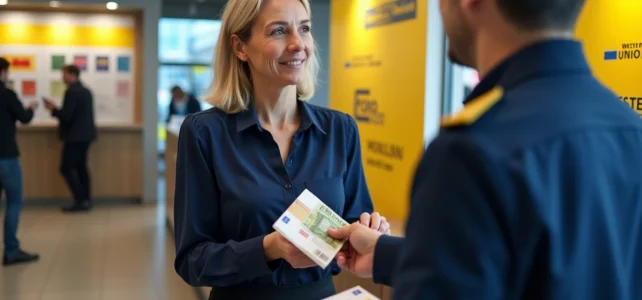
Sending money via Western Union from France remains a common operation, whether to an African, Asian, or South American country. The service relies on a still dense physical network, but is increasingly challenged by its own digital channels. Since October 2025, European regulations require a systematic verification of the beneficiary before validating transfers, which significantly alters the sending process for French residents.
Identity verification and regulatory compliance before any transfer
Even before choosing an amount or a destination country, the first step concerns the identification of the sender. Western Union requires a valid identification document (national identity card, passport, residence permit). This verification is not a mere formality: it conditions access to the service.
In the agency, the agent scans the document and enters the information into the system. Online or via the app, the user must upload a copy of the document, sometimes accompanied by a confirmation selfie. The process can take a few minutes or several hours depending on the workload of the compliance teams.
The new European obligation to verify the beneficiary adds an additional layer. Specifically, when the transfer goes through a European bank transfer, the system compares the recipient’s name with the information from the receiving account. In case of inconsistency, the transfer may be suspended. To find out how to send money with Western Union in France while respecting these constraints, it is better to check in advance the exact spelling of the beneficiary’s name as it appears on their official documents.

Payment method and type of receipt: what changes regarding timelines
The choice of payment method at the time of sending and the method of receipt upon arrival directly determines the speed of the money transfer. This point is often underestimated by occasional senders.
Sending by credit card with cash withdrawal
This is the fastest combination. The sender pays by card, and the beneficiary withdraws cash at a Western Union payout point abroad. This type of transfer is generally almost immediate, provided that the amount does not trigger an internal control.
Sending to a bank account
Transfers to a bank account follow a different rhythm. Funds may remain pending for several days, depending on the compliance checks applied by Western Union, as well as the local rules of the receiving country. If the beneficiary does not withdraw the funds (in the case of a cash withdrawal), a refund remains possible.
Cash payment at the point of departure, made at an agency or post office, remains available in France. However, financial analysts observe a continuous decline in retail activity in agencies, compensated by the rise of digital channels. For regular sending, the mobile app offers a transaction history and finer traceability.
Western Union transfer security: concrete points of vigilance
The security of a Western Union money order is not limited to the encryption of the transaction. It also depends on the sender’s behavior and the reliability of the information transmitted.
- Never share the transfer tracking number (MTCN) with anyone other than the intended beneficiary. This code is the key to withdrawal: anyone who possesses it, combined with an identification document, can collect the funds in certain countries.
- Verify the real identity of your contact if you are sending money following a request received by phone, email, or social media. Scams involving fake relatives in difficulty represent a recurring scenario.
- Keep the transaction receipt and the MTCN number until confirmation of receipt by the beneficiary. In case of dispute, these are the only usable proofs.
Western Union also deploys fraud detection systems based on artificial intelligence, integrated into the validation process. These systems analyze unusual transaction patterns (atypical amount, high frequency, high-risk countries) and may block a sending for further verification. This blocking is not a malfunction: it is a protective mechanism that can delay the availability of funds from a few hours to a few days.
Fees and exchange rates: reading beyond the displayed amount
The total cost of a Western Union transfer includes two distinct components that the sender must add together to know the actual price of the operation.
The first is the fixed or variable commission, which depends on the amount sent, the destination country, the payment method (card, cash, transfer), and the receipt method. The same amount sent to the same country can cost differently depending on the chosen channel.
The second component is the margin applied on the exchange rate. Western Union sets its own rate, distinct from the interbank rate. The difference between the two constitutes an implicit cost, rarely highlighted during the sending process. For a transfer of a few dozen euros, this margin may seem negligible. On higher amounts or frequent sendings, it significantly impacts the annual budget.
The Western Union online simulator allows you to visualize these two items before confirming. Comparing with other money transfer services remains the best way to assess whether the balance between speed and cost suits your situation.
Agency or app: money transfer in France shifts to digital
The trend is clear. Transfers via the Western Union app or website are increasing, while visits to agencies are declining. This shift has practical implications for senders in France.
Online, the service is accessible continuously, documents are stored digitally, and tracking notifications arrive in real-time. In the agency, the advantage remains cash payment, useful for unbanked individuals or those who prefer not to link their bank card to the service.
Both channels apply the same compliance and verification rules, but processing times may vary. A sending initiated online on a Sunday evening will not be processed at the same speed as a sending made in agency on a Tuesday morning.
The choice between agency and app thus depends on the desired payment method, the urgency of the transfer, and the sender’s level of digital comfort. Neither channel offers a systematic advantage in terms of security: anti-fraud controls apply equally.