
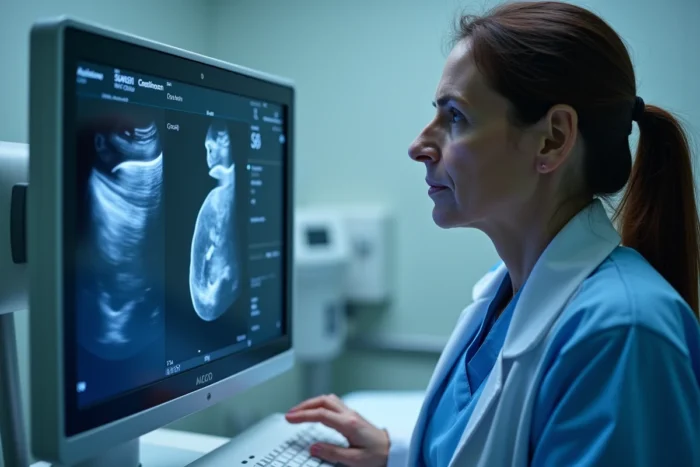
Even before the placenta is formed, the human embryo begins a biological dialogue with the maternal organism. This first exchange between the mother and the fetus does not occur through the blood or the umbilical cord: it relies on molecular signals emitted as early as implantation, just a few days after fertilization. Understanding this timeline helps to grasp how much the physiological relationship between mother and embryo precedes what prenatal imaging makes visible.
Immune dialogue from implantation: the first mother-embryo exchange
Most descriptions of pregnancy start the exchanges when the placenta becomes functional, around the end of the first trimester. The biological reality is earlier. From day 6 after fertilization, the trophoblast (the outer cell layer of the embryo) comes into direct contact with the maternal endometrium at the time of implantation.
This trophoblast then secretes molecules such as HLA-G and several cytokines that reprogram the local immune cells of the endometrium. Uterine NK cells, macrophages, and regulatory T lymphocytes modify their behavior to tolerate the presence of a genetically distinct organism. This mechanism, called local immune tolerance, constitutes the very first functional exchange between the mother and the embryo.
This dialogue precedes by several weeks the organized flow of nutrients. It is not yet a transfer of nutritional substances, but an active cellular communication without which implantation would fail. To better understand when placental exchanges begin according to Vitalomia, this implantation phase is the starting point to consider.
Formation of the placenta: when nutritional exchanges really begin
The placenta does not appear all at once. Its construction spans several weeks, and its functional maturation does not coincide with the medically dated beginning of pregnancy.
The first weeks without shared blood circulation
Between implantation and around the fourth week of pregnancy, the embryo nourishes itself by diffusion from the surrounding maternal tissues. There is not yet a true shared blood circulation. The trophoblast forms villi that penetrate the uterine wall and capture nutrients through direct contact, without maternal blood circulating in an organized network.
This period is often overlooked in pregnancy narratives. The embryo is already metabolically active and dependent on the maternal environment, even in the absence of a functional umbilical cord.
Establishment of placental circulation
Around the fourth week of pregnancy, a blood circulation is established between the embryo and the forming placenta. The umbilical cord begins to structure, connecting the embryo to the chorionic villi where gas and nutrient exchanges will occur.
The placenta does not reach its full functionality until the end of the first trimester. Before this stage, exchanges exist but remain limited in volume. The placental barrier, this thin layer of cells that separates maternal blood from fetal blood, gradually takes shape. It allows the passage of oxygen, glucose, and amino acids to the fetus while filtering out some pathogens.
- Oxygen and carbon dioxide cross the placental barrier by simple diffusion, depending on the concentration gradient between the two blood circulations.
- Glucose, the main energy source for the fetus, passes through facilitated transport across the placenta cells.
- Maternal IgG antibodies cross the placental barrier, especially in the third trimester, providing temporary immune protection to the baby after birth.
- Some undesirable substances (alcohol, nicotine, medications) also cross this barrier, which explains the strict recommendations during pregnancy.
Fetal microchimerism: a cellular exchange that exceeds pregnancy
The exchanges between the mother and the fetus are not limited to nutrients and gases. Fetal cells cross the placental barrier and settle permanently in the maternal organism. This phenomenon has a name: fetal microchimerism.
Fetal-derived cells have been detected in maternal blood and tissues years after childbirth. They have been found in various organs such as the liver, thyroid, or brain. This cellular transfer begins during pregnancy, as soon as the placental circulation is sufficiently established to allow the passage of whole cells.
Effects still poorly understood on maternal health
The available data do not allow for definitive conclusions about the role of these fetal cells in the maternal organism. Some observations suggest that they may participate in tissue repair. Other studies point to a possible association with certain autoimmune diseases.
Microchimerism is even observed in pregnancies that do not go to term, which means that a cellular exchange can occur very early. Male-derived cells have even been identified in women who have never carried a boy, likely inherited from their mother’s previous pregnancies. The mother-fetus exchange thus exceeds the scope of a single pregnancy.
Placental barrier: selective filter and not an impermeable wall
The term “placental barrier” can be misleading. It is not an impermeable wall that isolates two organisms. The placenta functions as a selective filter with variable permeability depending on the stage of pregnancy and the nature of the molecules.
In early pregnancy, the barrier is relatively thick and the passage of substances remains limited. Over the weeks, it thins to allow for more intense exchanges, necessary for the rapid growth of the fetus in the second and third trimesters. This evolution explains why certain toxic exposures have different consequences depending on the timing of pregnancy.
The role of the placenta is not limited to passive transfer. It produces hormones (hCG, progesterone, placental lactogen) that modify maternal metabolism to direct resources toward the fetus. The placenta acts as an autonomous endocrine organ, not just as a simple conduit.
The exchange between the mother and the fetus therefore begins much earlier than most expectant parents imagine. From implantation, a molecular dialogue is established. It transforms into nutritional flows with the maturation of the placenta, then into lasting cellular transfer with microchimerism. Each step redefines the boundary, increasingly porous, between two organisms that are never truly separate during pregnancy.