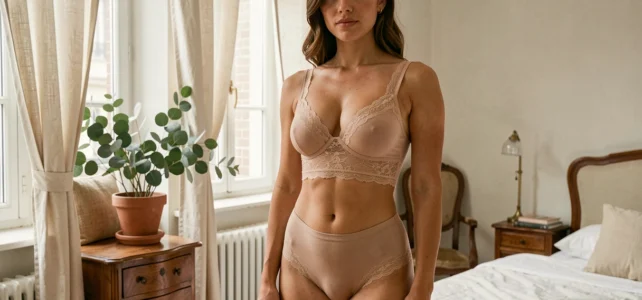
Finding a bra that really stays in place when you move, high-waisted panties that don’t roll down on the belly, a bodysuit that you can put on without contorting: these are the concrete frustrations that are shaping lingerie trends this year. Current collections respond to body shape constraints and everyday comfort rather than just fleeting fashion effects.
Adaptive sizing and extended sizes in lingerie
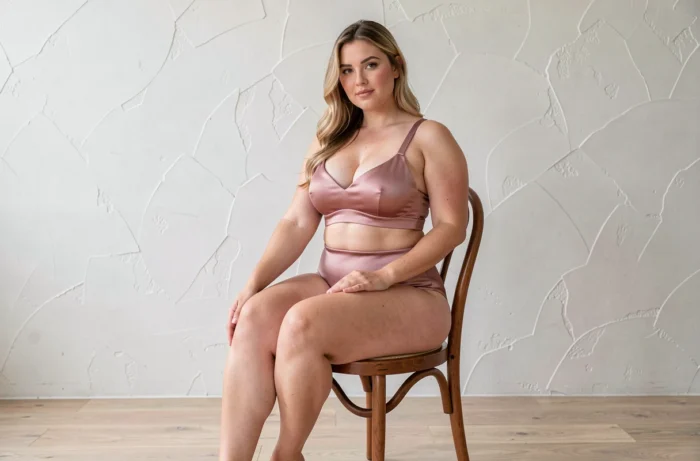
We often talk about inclusive sizes, but the real issue on the ground is the pattern making. An E cup cut like an enlarged B cup holds nothing. The brands making progress this year are reworking the cut from the ground up: wider underwires, straps redistributing weight over a larger surface, reinforced side panels.
On the panties and bottoms side, high-waisted shaping styles are making a comeback with wide elastic waistbands. Their function is simple: smoothing without compressing, holding without marking the skin. We also find models with flat seams, designed to be worn under fitted clothing without creating visible lines.
Coordinated sets adapted to various body shapes can be found at specialized boutiques like lingerie-dement.com, which offer pieces designed to combine support and aesthetics without compromising on size.
Structured lace and technical fabrics for everyday wear
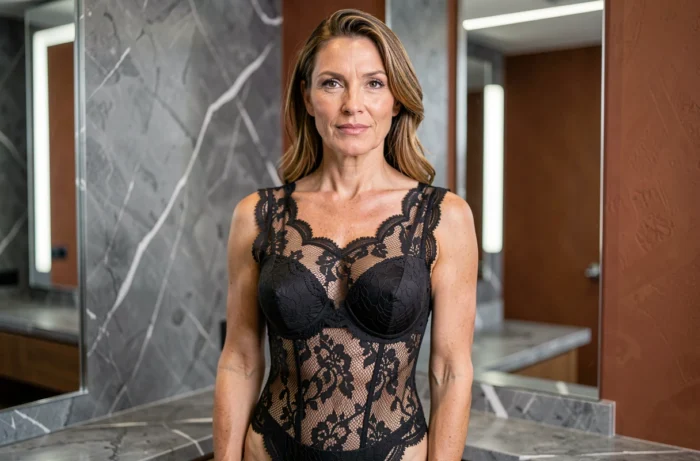
Lace remains a classic, but its trendy version has changed. We are seeing lace lined with microfiber, durable enough for everyday use. The result: a refined look without the usual fragility or itching after a few hours.
Technical fabrics from sportswear are infiltrating everyday lingerie. Quick-drying, thermoregulating, or odor-resistant materials are found in bras and panties designed to be worn from morning to night, not just at the gym.
Specifically, when choosing a bra made from technical fabric, we check two points: the density of the mesh (if it’s too thin, it stretches quickly) and the presence of elastane in the side seams, not just in the cup. Feedback varies on the durability of these materials in washing, but models with a high percentage of recycled polyamide seem to hold up better over time.
Saturated colors and durable basics: the end of ephemeral capsules
Fuchsia, cobalt blue, and deep green are gradually replacing powdery shades in this year’s collections. This shift towards bright colors is not just aesthetic. It reflects a change in industrial logic linked to a recent regulatory constraint.
Since July 19, 2026, large companies are no longer allowed to destroy their unsold new textiles in the European Union, except for rare exceptions. Very ephemeral collections focused on a single seasonal color become a risk of dead stock. The result: brands are betting on more limited but bolder color ranges designed to stay on shelves for several seasons.
For buyers, this translates into pieces with bolder shades, multi-body basics available for longer, and a better chance of finding their favorite model in restock. Ultra-limited capsules are not disappearing, but they are becoming the exception rather than the norm.
Which colors to prioritize based on your wardrobe
The choice of lingerie color depends as much on what you wear over it as on your personal tastes. Here are some concrete guidelines:
- Under a white shirt or light blouse, a bra in a shade close to your skin tone remains invisible, regardless of current trends
- Saturated colors (burgundy, emerald, midnight blue) work well under dark clothing and add a fashionable dimension without being visible
- Black remains the most versatile choice for everyday pieces, but bright shades take over as soon as you want to match lingerie and outfit
Textile digital passport: what changes for choosing your lingerie
A less visible but structural change is coming in the next few years. The European ecodesign regulation (ESPR) gradually imposes a digital product passport for textiles, accessible via a QR code on the label. The first requirements are expected to start in 2027.
Every bra or panty sold in Europe will need to display a sheet detailing composition, origin, durability, repairability, and recycling options. For consumers, this is a concrete tool: you will be able to scan a label in-store and know exactly for what lifespan the product was designed.
This system also paves the way for sheets that specify for which type of breast or silhouette the pattern was designed. Instead of relying solely on a standardized size, we will have access to information about cup depth, strap spacing, or waistband height.
What to check right now on a label
While waiting for the full rollout of the digital passport, certain information already deserves attention at the time of purchase:
- The exact composition: a blend with at least one-third natural fibers (cotton, modal) generally offers better wearing comfort
- The country of manufacture, which gives an indication of the production standards applied
- The care instructions, often overlooked but crucial for the longevity of a bra (the dryer destroys elastics in a few cycles)
- The mention of recycled materials, increasingly present in recent collections
This year’s lingerie trends converge towards a common point: pieces designed to last and adapt to real bodies. Between new regulatory constraints on unsold goods and the arrival of the textile digital passport, the market is restructuring around durability and precise pattern making.
The choice of good lingerie relies less on the latest trend than on a piece’s ability to meet its morphology and withstand the test of washes.