
When a mid-table club finalizes its budget and TV rights account for only a fraction of its revenue, the question is no longer how much it receives, but how it compensates. The 2026-2027 Ligue 1 season illustrates this shift: French clubs are building their finances on radically different foundations than they were five years ago.
Wage bills remain the largest expense, matchday revenues are gaining ground, and reliance on transfers has never been more visible for certain squads.
TV Rights in Ligue 1: The End of a Dominant Funding Model
Before the Mediapro crisis, television rights could account for about half of the revenue of an average Ligue 1 club. That time is over. For the 2026-2027 season, the share of TV rights has fallen to between 10 and 20% of the budget for many clubs, according to several sector analyses. The launch of the Ligue 1+ platform and the end of major successive contracts (Mediapro then DAZN) have accelerated this erosion.
By analyzing the budget of Ligue 1 clubs, it is clear that this drop has not affected everyone equally. Clubs with strong ticket sales or a robust sponsor portfolio are better able to absorb the shock. Others find themselves compensating through player sales, sometimes as early as the first summer transfer window.
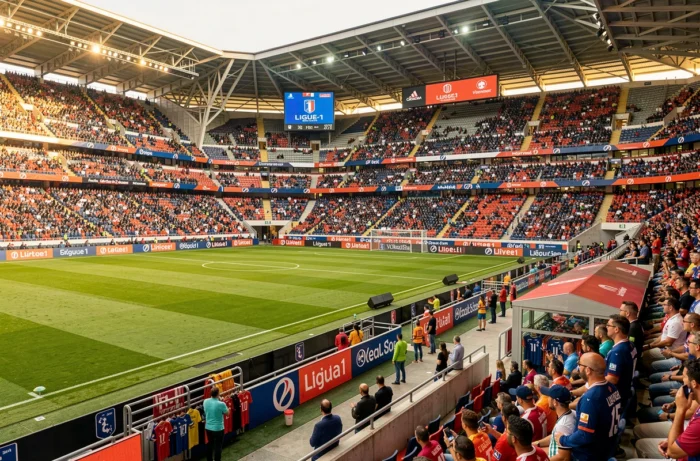
Distribution of TV Rights: The Reform Changing Budgets in 2026
Beyond the total amount, it is the distribution key that has been profoundly modified. The old grid could create a gap of up to a 1 to 6 ratio between the best-funded club and the least well-served. The new distribution reduces this concentration in favor of lower-table clubs, which receive a structurally higher share.
In practical terms, for a promoted club or one fighting to stay up, this rebalancing can represent several million euros more per season. This is significant when some total budgets at the bottom of the table hover around a few tens of millions.
What This Means for Mid-Table Clubs
A club like Montpellier or Le Havre can no longer build its budget around a single pillar. The reform pushes towards a three or four-legged model:
- Sponsorship (jersey, naming, local partnerships), which becomes the primary source of income for several mid-table clubs
- Ticket sales and matchday revenues, boosted by stadium renovations and aggressive subscription policies
- Capital gains from transfers, which remain the most volatile but also the most profitable lever in the short term
- Redistributed TV rights, now a supplement rather than a base
Foreign Investors and Ligue 1 Budgets: 72% of Clubs Under Foreign Capital
The figure is striking: 13 out of 18 clubs in Ligue 1 are controlled by foreign capital for the 2026-2027 season, representing 72% of the league’s teams. This is no longer a marginal phenomenon reserved for PSG or OM.
One might think that foreign capital automatically means inflated budgets. The reality is more nuanced. Some investors inject massive amounts, with PSG remaining in a category of its own. Others buy clubs with a medium-term profitability logic, betting on training and resale.
The Concrete Impact on Wage Bills
The DNCG is keeping a watchful eye. Every budget is validated by the financial watchdog of French football, and several clubs have had to revise their forecasts downward before the start of the season.
The wage bill typically absorbs the largest share of a professional club’s expenses. When an investor arrives with high sporting ambitions, the temptation to recruit widely exists, but the French regulatory framework imposes a de facto ceiling. Clubs that exceed the allowed ratios are prohibited from certain signings, or even administratively relegated.

2026-2027 Transfer Window: Where French Clubs’ Spending Really Goes
The summer transfer window of 2026-2027 reveals very contrasting strategies. Some clubs like Brest or Le Mans had not yet spent anything by mid-window, while others were already committing significant sums.
Transfer spending does not always reflect the total budget. A club may show a high budget but invest little in transfers, preferring to rely on its training center. Conversely, a club with a modest budget may concentrate its resources on one or two targeted signings, even if it temporarily disrupts its finances.
- Clubs with large budgets often prefer permanent transfers to secure their squad for several seasons
- Mid-table clubs multiply loans with an option to buy, limiting immediate financial risk
- Promoted teams and small budgets focus on free players and contract expirations, reducing transfer fees to zero
OM and Its Finances to Sort Out
Olympique de Marseille embodies this tension between sporting ambition and accounting reality. The club is entering a new era with a “very significant accounting gap” to fill, according to regional press. Getting finances in order while remaining competitive is the main challenge for the Marseille management this season.
French football is entering a phase where financial management weighs as heavily as sporting recruitment. The clubs that will come out on top in 2026-2027 will not necessarily be those that spend the most, but those that have diversified their revenues before the next renegotiation of TV rights reshuffles the deck.