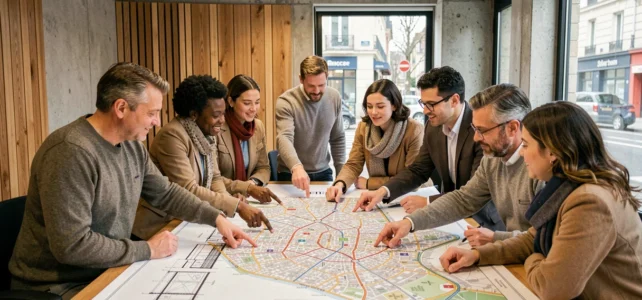
Rennes allocates a portion of its investment budget each year to fund projects directly proposed by residents. This mechanism, the participatory budget, serves as the most visible foundation of local citizen participation. However, other forms of engagement, less institutional, are simultaneously reshaping how the people of Rennes create their city.
Civic Funding in Rennes: Circuits that Bypass the City Hall
The municipal participatory budget captures media attention, but an increasing part of civic engagement in Rennes is taking distinct channels. Since 2021, structures for citizen funding focused on ecological transition have emerged in Rennes, allowing residents to invest directly in low-carbon solutions.
These citizen holdings finance innovative local businesses and clean energy projects without going through the local authority. The model is based on a participatory investment logic where each contributor becomes a shareholder in a concrete project.
The dynamic driven by Rennes en commun 2020 illustrates this desire to structure citizen action beyond just municipal mechanisms, bringing together collectives around common urban transformation goals.
What distinguishes these initiatives from the classic participatory budget boils down to three points:
- The financial backing is provided by the citizens themselves, not by the local authority. The risk and return are shared among investors.
- The projects target specific sectors (energy, mobility, food) where the participatory budget covers a broader spectrum, from the development of a square to the installation of composters.
- The timing differs: a citizen investment commits for several years, while a participatory budget project follows an annual cycle of submission, voting, and realization.
Participatory Budget of Rennes: Comparison of Forms of Citizen Participation
| Criterion | Municipal Participatory Budget | Citizen Funding (holdings) | Childhood Territories Program |
|---|---|---|---|
| Target Audience | All residents of Rennes, regardless of age or nationality | Investing residents | Children and youth |
| Management | City of Rennes | Citizen private structures | UNICEF / City of Rennes |
| Fields | Urban planning, culture, environment, mobility, health | Ecological transition, clean energy | Mental health, urban planning, safe routes |
| Decision-Making Mechanism | Project submission followed by resident voting | Direct investment | Co-construction with minors |
| Cycle | Annual (seasonal) | Multi-year | Continuous |
This table highlights a structural gap. The participatory budget remains the only mechanism open to all without financial conditions. In contrast, citizen holdings imply an investment capacity that inherently limits their accessibility.
Rennes First City of Childhood Territories: What Changes with Minor Participation
In 2026, Rennes became the first city in France to join UNICEF’s Childhood Territories program. This program aims to integrate children into the definition of local public policies, an angle that classic participatory budgets do not directly address.
Specifically, the mechanism includes the establishment of participatory budgets dedicated to children, prioritizing mental health as a public policy axis, and urban developments designed “at children’s height”: safe routes, walking buses, school streets, adventure parks co-constructed with youth.
The significance of this program goes beyond mere consultation. It institutionalizes a form of citizen participation for minors that sets a national precedent. Children are no longer consulted occasionally on a schoolyard project; they are involved in defining municipal priorities themselves.

A Leverage Effect on Adult Mobilization
Experiences from the Rennes participatory budget show that projects led by schools or youth collectives generate broader mobilization. Parents, teachers, and neighborhood associations join these initiatives, expanding the participation base beyond already engaged citizens.
Participatory Projects and Citizen Protest: The Tension Structuring the Rennes Debate
Citizen participation in Rennes is not limited to institutional mechanisms. More conflictual forms of mobilization coexist with the participatory budget. For example, a petition opposed a real estate project near the Gayeulles park, illustrating an organized citizen protest against planning choices.
This tension between institutional participation and protest mobilization is not trivial. It reveals a gap between the issues the city submits for voting (local developments, greening, urban furniture) and the challenges that truly mobilize residents (densification, soil artificialization, quality of life).
The participatory budget allocates each year a defined portion of the investment budget to citizen projects, but this envelope does not cover structural urban planning decisions. Residents who wish to influence these choices must resort to other levers: petitions, citizen interventions via the Citizen Factory, or direct associative mobilization.
Right of Intervention: An Underutilized Tool
The Citizen Factory of Rennes offers a right of intervention that allows residents to bring specific issues before the municipal council. This mechanism remains underutilized compared to the participatory budget, even though it addresses substantive questions that the annual vote does not cover.
The future of citizen participation in Rennes will likely hinge on the articulation between these different tools. The participatory budget works for local projects, citizen funding captures commitments on ecological transition, and the Childhood Territories program opens participation to minors.
Rennes now overlays at least four distinct participation mechanisms, each with its audience, scope, and limitations. The question is no longer whether the people of Rennes participate, but whether these mechanisms communicate with each other.