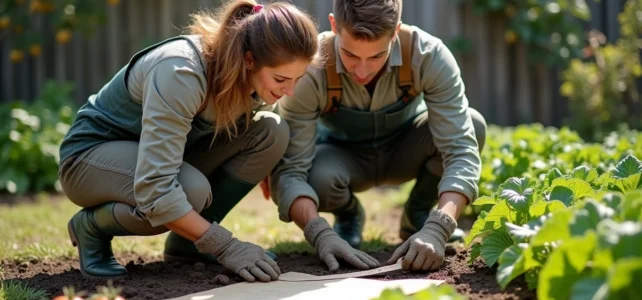
A couple deciding to grow their own vegetables quickly faces a very concrete problem: the available land rarely matches the theoretical areas one reads about everywhere. Between a city garden and a rural plot, the answer cannot be the same.
The area of a vegetable garden to feed two people depends less on a magic number than on what one is willing to grow, and especially on how each square meter is organized.
Biotope coefficient and urban planning rules: what reduces the actually cultivable area
Before even talking about vegetables, one must check what the local urban planning plan (PLU) allows. More and more municipalities are incorporating a biotope coefficient into their regulations. This coefficient requires that a minimum proportion of the plot be favorable to biodiversity: hedges, ground cover, non-impermeable areas.
In practice, this means that a very intensive vegetable garden with concrete pathways and no wild areas can pose problems, even if one stays at home. A couple wanting to maximize food production must balance cultivated area and the ecological performance of the plot.
This parameter is rarely mentioned in traditional gardening guides, yet it changes the game for anyone setting up a vegetable garden in urban or peri-urban areas. It is recommended to consult the PLU before marking out the beds, as detailed in this vegetable garden guide on Le Jardin de Gaïa that addresses the sizing issue for two people.
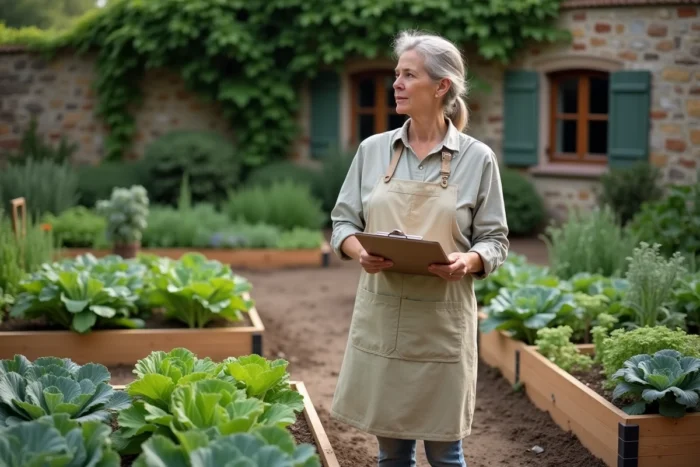
Vegetable garden area for 2 people: think in useful beds, not raw land
Common estimates hover around a few dozen square meters per person to cover a significant portion of fresh vegetable needs. But this number means nothing if we do not distinguish between the actually planted area and the total area occupied.
A vegetable garden always includes pathways, a compost corner, sometimes a tool shed or a rainwater collection tank. These elements easily consume a third of the gross area. When a large vegetable garden area is announced, the effective cultivation area is much smaller.
What matters: planting density per bed
Rather than thinking in terms of total area, it is beneficial to think in terms of the number of beds and density. A well-managed cultivation bed (vegetable associations, successive sowings, mulching) produces significantly more than the same area cultivated in spaced rows the old-fashioned way.
- Leafy vegetables (lettuces, spinach, mâche) are sown densely and harvested continuously from the same bed, several times per season.
- Tomatoes and zucchinis require more space per plant, but one zucchini plant is more than enough for two people during the summer.
- Radishes and herbs can be interspersed between the main crops without dedicating specific area.
Three to four well-managed cultivation beds cover most of a couple’s fresh vegetable needs between May and October. The challenge is not to have a large plot, but to rotate the crops on each bed.
Choice of vegetables and actual yield: where to focus the effort
Not all vegetables are equal in terms of yield per square meter. A couple looking to optimize their area should make decisive choices rather than trying to grow everything.
High-yield crops for a small vegetable garden
Tomatoes remain the best surface investment for a couple. A few well-managed plants (pruning, staking, regular watering) provide kilos of fruit over a season. Climbing green beans take advantage of verticality and free up ground. Squashes, if allowed to sprawl along the edge of the garden or on a slope, produce a lot without occupying a bed.
Conversely, potatoes and corn are very space-consuming for a modest yield relative to their store price. For a couple with limited space, these crops are not a priority.
Spreading production throughout the year
The real difficulty is not producing enough in summer (the bountiful season), but harvesting something between November and March. Feedback on this varies depending on the climate and exposure of the land.
Leeks, mâche, and certain cabbages withstand the cold and allow for extending the harvest season well beyond autumn. Planning staggered sowings from spring, rather than planting everything at once, avoids the classic production peak followed by weeks with nothing to harvest.
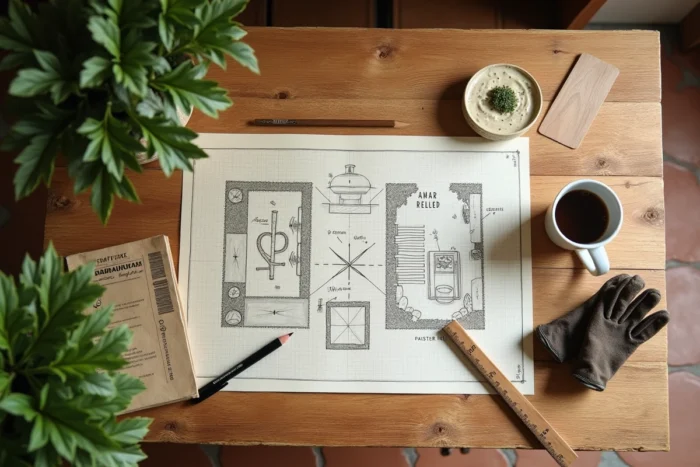
Soil and land preparation: the underestimated factor
You can have the ideal area and still fail at your vegetable garden if the soil is not suitable. Compacted, overly clayey, or depleted soil after years of closely mown lawn will yield little in the first year, regardless of the area.
Preparing the soil as early as the previous autumn radically changes the results: thick mulching, compost addition, and loosening with a broadfork. It is a time investment that pays off over several seasons.
A couple starting out often benefits from beginning with a modest, well-prepared area rather than turning over a large square of land. Two or three well-amended beds in the first year, followed by gradual expansion each autumn, yield better results than a large, poorly nourished garden.
Square or bed vegetable garden: what layout for a couple
The square vegetable garden appeals to beginners for its clarity, but it has a drawback: the borders and divisions consume a lot of useful area. For a couple, long and narrow beds are more efficient in terms of cultivated area to total area ratio.
A bed 1.20 m wide allows for working on both sides without stepping on the soil. The length adapts to the available land. With 40 cm pathways between the beds, surface loss is minimized while maintaining convenient access for weeding and harvesting.
The square remains relevant on a terrace or balcony with raised beds, where the constraint is the ground load and soil volume, not the surface area. The two approaches do not address the same problem.
The vegetable garden area for a couple does not have a single answer. A well-prepared plot, vegetables chosen for their yield, staggered sowings throughout the season, and a compact bed layout matter more than raw square meters. Three productive beds are better than a large garden that is only half maintained.