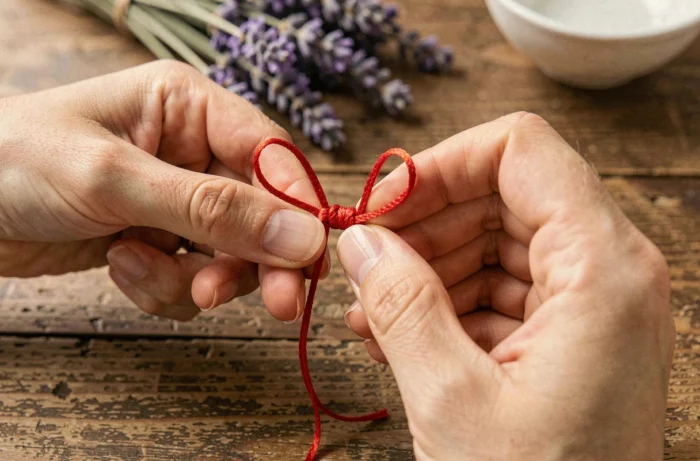
We’ve all seen those red bracelets with seven knots on someone’s wrist, without really knowing where to start to make one ourselves. The red 7 knots bracelet is based on a straightforward principle: a red wool thread, seven hand-tied knots, and an intention placed on each of them.
No need for expensive materials or a complicated ritual, but a few technical details make all the difference between a bracelet that lasts and one that comes undone in three days.
Choosing the thread: why red wool and not another cord
When browsing craft stores, you come across waxed cotton, jade thread, satin cord. For a 7 knots bracelet in tradition, the recommended material is red wool. Some recent sources clearly distinguish wool thread from cotton or silk variants, which are considered decorative adaptations rather than ritual supports.
Wool has a practical advantage: its fibers cling to each other when tightened. A knot on wool thread stays in place much longer than a knot on satin cord, which slips under the slightest tension. To learn how to make a red 7 knots bracelet properly, the choice of thread determines the strength of each knot and the overall durability of the bracelet.
In terms of thickness, aim for a thread that is neither too thin (it would break at the first snag) nor too thick (the knots would become unsightly lumps). A medium-thickness wool thread, comparable to standard knitting yarn, gives the best result.

Knotting technique: tightening a knot that holds without damaging the thread
The gesture seems basic, but many bracelets have knots that loosen after a few hours. The reason is almost always the same: the thread was not properly tightened before forming the loop.
Preparing the right length
Cut a thread about three times the circumference of the wrist. The seven knots consume more length than one might imagine, and you need to keep enough to close the bracelet at the end. It’s better to cut too long and trim later.
Forming each knot properly
Each knot is a simple overhand knot. You form a loop, pass the end through it, and pull on both sides while keeping the thread flat. Pulling slowly and evenly prevents the thread from twisting on itself.
The seven knots are spaced evenly along the length of the bracelet. They should not be bunched up in one spot. Regular spacing ensures that the bracelet remains flexible on the wrist and does not form a rigid lump.
- Keep the thread taut between your thumb and index finger before each knot to avoid slack
- Tighten each knot by pulling simultaneously on both sides, never just one
- Check after each knot that the thread has not twisted on itself (twisting weakens the fiber)
- Leave about a centimeter of space between each knot for flexibility
Activating the red 7 knots bracelet: placing an intention on each knot
The making is the visible part. The activation is what distinguishes a simple tied cord from a bracelet that carries meaning. The principle is based on an idea shared by several traditions: each knot fixes a specific intention in the fiber.
One intention per knot, not a vague wish
The difference between an intention and a vague wish changes the practice. “I want to be happy” yields nothing concrete. “I tie this knot for the protection of my health” or “this knot carries my intention of calm in conflicts” anchors something specific.
You tie each knot while mentally (or verbally) formulating the corresponding intention. The seven intentions generally cover distinct areas:
- Protection against negative energies and the evil eye
- Physical health and vitality
- Love and emotional relationships
- Inner serenity and emotional management
- Happiness and gratitude in daily life
- Success in ongoing projects
- Spiritual connection or personal grounding
Feedback varies on this point: some people assign a fixed area to each knot according to a specific order, while others choose freely. The order matters less than the clarity of each intention.
Breathing and concentration during knotting
Take a deep breath before tightening the knot, formulate the intention during exhalation, then tighten. This slow rhythm prevents rushing the gesture and forces concentration. A bracelet tied in thirty seconds in front of a Netflix series does not carry the same weight as a bracelet tied in silence, knot by knot.
Purifying the red thread before knotting: fumigation rather than saltwater
Before placing any intention, we clean the thread of the energies it may have absorbed during its manufacturing, transport, or storage. Two methods are often circulated: fumigation and soaking in saltwater.
Fumigation with white sage or palo santo is the most suitable method for a textile thread. Saltwater weakens wool fibers, alters the hold of knots, and can discolor the red. You light the sage stick, let the flame go out to keep only the smoke, then pass the thread through this smoke for a few minutes while slowly turning it.
For those sensitive to smoke or living in an apartment without ventilation, leaving the thread to rest overnight on a windowsill exposed to moonlight is a gentle alternative, often mentioned in textile purification practices.
Red bracelet on the left wrist: tradition and daily wear
According to the most widespread tradition, stemming from Kabbalah, the red bracelet is worn on the left wrist, considered the receptive side of the body, through which energy enters. The right wrist is associated with outgoing energy.
In practice, the bracelet is worn day and night until it naturally detaches. This gradual wear is interpreted as a sign that the thread has fulfilled its protective function. It is not removed voluntarily and is not re-tied once broken: a new one is made, with new intentions.
The version with seven knots is not universal to all cultures of the red thread. It is mainly associated with modernized uses of Kabbalah and contemporary reinterpretations. Knowing this does not diminish the value of the ritual but places the practice in its real context rather than in a false historical continuity.