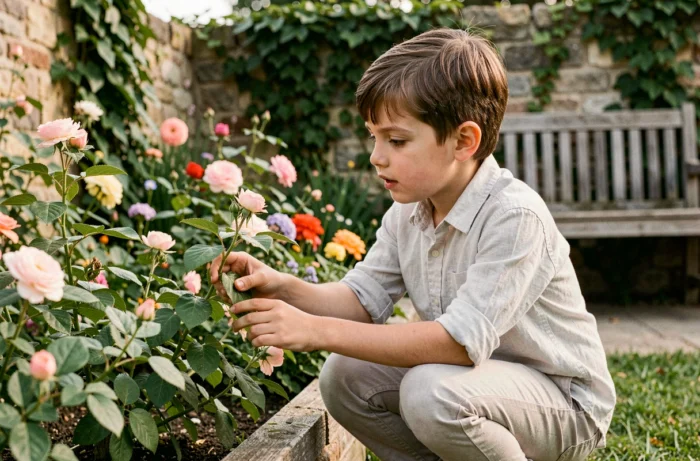
A child who places his thumbs on the ground and makes flowers spring up: this is the starting point of Tistou les pouces verts, the novel by Maurice Druon first published in 1957. This tale aimed at youth does not resemble a classic adventure story. It places nature at the center of a moral conflict between a warrior adult world and the pacifist vision of a boy who refuses the established order.
Maurice Druon, an academic in children’s literature
Maurice Druon is generally associated with the historical saga Les Rois maudits or his role at the Académie française. His foray into children’s books still surprises. Druon did not write Tistou to simplify his writing: he transposed very adult political and philosophical concerns into a form accessible to younger readers.
The novel was published in a post-war context where France was seeking a new cultural breath. Paris was then the center of literary debates about the engagement of authors. Druon chose an unexpected angle: to address his pacifist plea to children, not to intellectuals.
This approach remains rare in French children’s literature of the time. Most children’s novels prioritized entertainment or direct moral learning. Druon, on the other hand, constructed a political tale disguised as a gardening story. Anyone wishing to extend this reading will find material for reflection in an analysis of Tistou les pouces verts that details the significance of this narrative choice.

Ecological and pacifist tale: what Tistou really tells
Tistou lives in Mirepoil, a prosperous town thanks to cannon manufacturing. His father, Monsieur Père, runs this industry. The boy discovers that he has a gift: his thumbs make plants grow instantly. He decides to use this power to transform the town.
Have you ever noticed that children’s books often place the hero in front of a physical obstacle (a dragon, a mountain, a labyrinth)? Druon does the opposite. Tistou’s obstacle is abstract: the violence organized by the adult world. The cannons from the family factory go to war. The boy responds with flowers.
Nature as a non-violent weapon
The gardener Moustache teaches Tistou the trade of the earth. But the student quickly surpasses the master. Roses invade the hospital, honeysuckle covers the prison, and wild roses block the cannons. Each of Tistou’s plant interventions targets an institution that Druon criticizes:
- The austere hospital, where the sick suffer as much from the sadness of the place as from their illness, transforms through the color and fragrance of flowers
- The prison, a symbol of a rigid punitive system, disappears under vegetation to the point of becoming unrecognizable
- The arms factory, source of the family’s wealth, becomes paralyzed when nature reclaims its rights over the war machines
This narrative scheme makes Tistou a precursor of ecological tales for youth. The plant replaces the sword as a tool for resolving conflicts.
Influence of Tistou on contemporary children’s literature
Why does this novel continue to circulate in school libraries and reading programs in France? The answer lies in its ability to address heavy subjects (war, social injustice, conformism) with accessible vocabulary and constant humor.
Druon plays with chapter titles, puns, and plot twists. This tone has paved the way for a generation of children’s authors who refuse to condescend to their audience. The child reader is treated as an interlocutor capable of grasping irony.
A text reread through the ecological lens
Foreign publishers’ catalogs that have republished Tistou since the 2010s explicitly present it as a classic of children’s literature, on par with Le Petit Prince by Saint-Exupéry. This rereading highlights the ecological and pacifist dimension of the text, more pronounced than it was in the initial Francophone reception.
Recent educational frameworks on climate and biodiversity education encourage the mobilization of tales to address individual environmental responsibility. Tistou perfectly fits this type of story that can be used in class. Educational sequences now link it to eco-citizen gardening projects, merging literary reading with civic education.

Tistou compared to Le Petit Prince: two tales, two narrative strategies
The comparison with Le Petit Prince often arises. Both books share a child hero confronted with the absurdity of the adult world. Both use the marvelous as a critical lever. However, the differences are clear.
Saint-Exupéry situates his story in a desert and on distant planets: the reader is displaced from reality. Druon anchors Tistou in an ordinary French town, with a factory, a garden, and a school. The marvelous emerges in the everyday, not in the elsewhere. This choice makes the message more directly political.
Le Petit Prince questions solitude and the meaning of life through contemplation. Tistou acts. He physically transforms his environment. This distinction has nourished different pedagogical approaches:
- Le Petit Prince often serves as a basis for abstract philosophical discussions about friendship or loss
- Tistou fits better into concrete projects that blend reading, natural sciences, and moral and civic education
- Teachers who choose Druon generally seek a text that leads to action (planting, observing, maintaining a garden)
Druon’s novel remains less known abroad than that of Saint-Exupéry. Its new international circulation could change this, driven by the growing interest in stories that articulate fiction and environmental awareness.
Tistou les pouces verts has traversed several decades without losing its relevance. A tale written in post-war France speaks today to CM1 classes planting seeds in the schoolyard. The strength of the book lies in this gap: a story that appears simple, yet raises questions that adults still struggle to answer.