10-micron gold plating occupies a unique place in the jewelry market. Often presented as a guarantee of superior longevity, this thickness of gold plating does not, however, benefit from any distinct regulatory category in France. Between commercial promise and technical reality, there are few benchmarks to evaluate what one is actually paying for.
10-micron gold plating: what the 1984 decree does not provide
The French legal framework sets a threshold, not a scale. The decree n°84-623 of July 16, 1984 reserves the designation “gold plated” for items covered with a layer of gold of at least 3 microns. Below that, it is referred to as “gold plated with fine gold.”
Beyond 3 microns, there is no additional legal distinction. A piece of jewelry at 5 microns and a piece at 10 microns carry the same regulatory designation. The mention “10 microns” is therefore a commercial positioning, often referred to as “high thickness gold plating” or “heavy plating” in professional catalogs.
This lack of a specific legal category has a direct consequence: nothing obliges a manufacturer to prove the announced thickness beyond the 3-micron threshold, except in the case of checks by the DGCCRF regarding commercial fairness. To better understand the price of 10-micron gold plating, one must first consider this regulatory ambiguity that leaves a wide margin for interpretation for brands.

Plating thickness and actual durability: what microns change
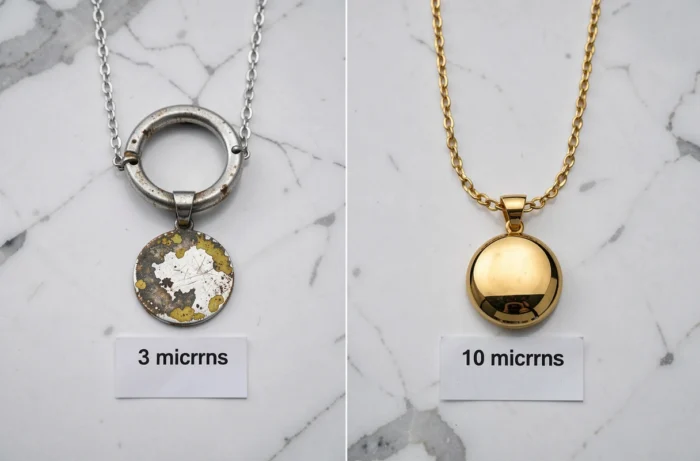
The thickness of the plating determines resistance to wear, but the relationship is not linear. A 3-micron gold-plated piece worn daily shows visible signs of wear after a few months to a year, depending on friction areas. At 5 microns, the durability significantly increases.
At 10 microns, the layer of gold offers significantly greater resistance to everyday micro-abrasions. Field reports vary on this point: some jewelers claim several years of durability, while others qualify it based on the type of jewelry. A ring undergoes mechanical stresses that are incomparable to those of a pendant.
Factors that accelerate the wear of gold plating
- Contact with skin acidity, which varies from person to person, attacks the layer of gold through a slow chemical reaction. Acidic skin degrades the plating more quickly.
- Cosmetics (perfumes, creams, hydroalcoholic gels) contain chemical agents that gradually dissolve the gold plating, even on thicker layers.
- Repeated mechanical friction (bracelet against a desk, frequently handled ring) wears the surface through abrasion, regardless of the initial thickness.
A 10-micron plating does not make a piece of jewelry immortal. It postpones the deadline, without eliminating it. The thickness delays wear but does not change the mechanism of degradation.
Price of 10-micron gold plating: why the gap with 3 microns remains moderate
The price of the raw material (the pure gold used for plating) represents only a fraction of the final cost of a gold-plated piece of jewelry. Tripling the thickness of the gold plating does not triple the selling price. Several reasons explain this gap, which is often perceived as small.
The amount of gold deposited on a piece of jewelry remains minimal, even at 10 microns. One micron equals 0.001 mm. Ten microns therefore represent one hundredth of a millimeter of gold on the surface of the jewelry. In relation to the gold price, the difference in material between 3 and 10 microns amounts to just a few euros for a standard-sized piece.
The actual additional cost comes more from the manufacturing process. A thicker plating requires a longer electrolysis time, enhanced quality control, and sometimes specific galvanic baths. These technical parameters inflate the production price, but in contained proportions.
The base metal influences the price as much as the thickness
The choice of base metal (brass, copper, silver) significantly alters the final cost. A solid silver piece plated with 3 microns of gold can cost more than a brass piece plated with 10 microns of gold. The base metal and the quality of the finish weigh as much as the thickness of the plating in the final price.
Brands that position 10 microns as a premium product also incorporate into their pricing the commercial margin related to the image of durability. The buyer pays partly for a promise of longevity and partly for a technical reality.
10-micron gold plating compared to gold filled and vermeil
10-micron gold plating is situated in a middle ground that deserves to be compared to two alternatives that are often confused with it.
Gold filled (or “laminated gold”) uses a sheet of gold mechanically bonded to the base metal, with a thickness of gold that represents at least 5% of the total weight of the piece. In practice, this corresponds to a layer much thicker than a 10-micron plating. Gold filled offers superior durability, but at a significantly higher price.
Vermeil refers to a piece of jewelry made of solid silver covered with gold. In France, vermeil requires a base of 925 silver and a minimum thickness of gold plating. Vermeil combines the nobility of the base metal with the gold finish but remains sensitive to silver oxidation if the gold layer wears off.
- 10-micron gold plating is suitable for regular use with a controlled budget, provided one accepts eventual renewal.
- Gold filled is aimed at those seeking durability comparable to solid gold without paying the price, with a more significant initial investment.
- Vermeil appeals to buyers who value the quality of the underlying metal, especially for skin that is reactive to nickel.
European standards on nickel and impact on thick gold plating
The REACH regulation imposes strict thresholds for nickel release for any object in prolonged contact with the skin. This constraint pushes some manufacturers to increase the thickness of gold plating, not only for durability but to create a more effective barrier between the nickel in the base metal and the skin.
A thin plating allows nickel to migrate more quickly as it wears. At 10 microns, the layer of gold significantly delays this migration. For allergic individuals, the thickness of the plating becomes a health criterion as much as an aesthetic one.
The available data do not allow us to conclude that a 10-micron plating completely eliminates the allergic risk in the long term. Wear eventually exposes the base metal, regardless of the initial number of microns. The only absolute guarantee remains a nickel-free base metal or a piece of solid gold.